
The argument happened during a family dinner at Nani's house last Diwali. My cousin Rohan, 24, fresh out of IIT Hyderabad, was complaining about his package. "₹12 lakh per annum sounds good on paper, Mummy. But after rent in Bangalore, EMI for the laptop, food, and sending money home — I have nothing left."
My Chachu — his father — nearly choked on his dal. "Beta, when I started at BHEL in 1992, my salary was ₹3,200 per month. You're making five times that."
"But your house in Bhopal cost ₹4 lakh, Chachu," Rohan shot back. "A flat in Bangalore costs ₹80 lakh minimum."
Then Nana ji, 82, sharp as always, put his chai down. "Chup karo dono. Let me tell you about real salary." And what followed was a two-hour history lesson that no textbook could match.
Nana Ji: The Government Servant (1968-1998)
Nana ji joined the Central Public Works Department (CPWD) as a Junior Engineer in 1968. He was 24 — same age as Rohan. India was a different country. Nehru had just passed away a few years ago. The country was still recovering from the 1965 war with Pakistan.
"Starting salary — ₹450 per month," Nana ji said, sipping his chai. "Second Pay Commission salary. Basic plus DA plus HRA. Total came to around ₹550 with allowances."
I did the math. ₹550 a month in 1968. Even I was shocked at how low it sounds. But Nana ji painted a different picture.
"Arrey, ₹550 bahut paisa tha. Rent for our 2-room quarter in Lucknow was ₹40 a month — government accommodation. Your Nani could feed the whole family — me, her, your mother and mausiji — for ₹80-90 a month. Atta was ₹1.80 per kilo. Milk was 60 paisa per liter. A full thali at the government canteen was 75 paisa."
| Expense | 1968 (Nana ji) | 1992 (Chachu) | 2024 (Rohan) |
|---|---|---|---|
| Monthly Salary | ₹550 | ₹3,200 | ₹1,00,000 |
| Rent | ₹40 | ₹800 | ₹25,000 |
| Monthly Groceries | ₹80 | ₹600 | ₹8,000 |
| School Fees (monthly) | ₹15 | ₹200 | ₹5,000+ |
| Savings Rate | ~35% | ~25% | ~5-10% |
Total monthly kharcha for a family of four: roughly ₹250-300. On a ₹550 salary, Nana ji was banking almost ₹200-250 every month. That's a 40%+ savings rate. Without trying hard. Without budgeting apps. Without side hustles.
"We bought our first proper house in 1975," Nana ji recalled. "Two-bedroom in Aliganj, Lucknow. ₹35,000. I paid ₹10,000 from savings and took a government housing loan for ₹25,000. EMI was ₹280 per month for 15 years."
By then, the Third Pay Commission had bumped his salary to about ₹1,200 per month. The EMI was less than 25% of his income. He was comfortable. Not rich — they had one ceiling fan, no fridge, no phone. But comfortable.
"Paisa ka value tha, beta. ₹100 ka note nikalo to dukandaar ka chehra khil jaata tha. Aaj ₹100 ki kya cheez aati hai?"
Chachu: The PSU Engineer (1992-2020)
My Chachu, Nana ji's son, joined BHEL Bhopal as a Graduate Engineer Trainee in 1992. He was 23, freshly married, and cautiously optimistic. India had just gone through the 1991 economic crisis. Liberalization was underway. There was a strange mix of anxiety and hope in the air.
"Starting salary — ₹3,200 per month," Chachu said. "Sounds decent compared to Papa's ₹550. But let me tell what happened alongside."
Chachu rented a 2BHK in a BHEL colony for ₹800 per month. With Chachi working as a school teacher at ₹1,800/month, their combined household income was ₹5,000. They were comfortable — but not as comfortable as Nana ji had been on a single income.
"In Papa's time, one salary was enough. My generation needed two incomes to match the same lifestyle. That's the first warning sign nobody noticed."
The Pay Commission Jumps
Chachu's career spanned three Pay Commissions — the 5th (1997), 6th (2006), and 7th (2016). Each one brought salary jumps that looked massive on paper.
- 1992: ₹3,200/month (starting)
- 1997: ₹8,500/month (5th Pay Commission bump)
- 2006: ₹22,000/month (6th Pay Commission)
- 2016: ₹65,000/month (7th Pay Commission)
- 2020: ₹85,000/month (retirement)
"Looks like I got rich, right? ₹3,200 to ₹85,000 — that's a 26x increase in 28 years." Chachu leaned forward. "But here's what happened to prices in those same 28 years."
The house they bought in 1998 for ₹4.5 lakh in BHEL Nagar is now worth ₹45 lakh. A 10x increase. Sounds great — except they refinanced it twice. Once for my cousin's coaching classes (₹2 lakh for two years of IIT prep). Once for Chachi's knee surgery (₹3.5 lakh — insurance covered only half).
"Medical costs destroyed us," Chachu admitted quietly. "In 1992, BHEL had full medical coverage. Free hospital, free medicines. By 2015, they moved to insurance-based coverage. ₹5 lakh limit sounds a lot until your wife needs a joint replacement."
The Hidden Costs Nobody Counted
Here's what I think people miss when they compare salaries across generations — it's not just about the base pay or the house prices. It's the thousand invisible cuts that add up.
Nana ji's employer provided quarters. Chachu paid rent, but BHEL colonies were subsidized — probably 40% below market rate. Rohan's paying full market rent in a metro city. That difference alone's maybe ₹10,000-15,000 monthly.
Then there's healthcare. Nana ji got free medical care at CPWD hospitals. Chachu had insurance, but with caps and co-pays. Rohan's company insurance doesn't cover parents, so he's paying ₹3,500 monthly for a family floater. That's ₹42,000 annually just for the privilege of not going bankrupt if someone gets sick. Honestly, it's hard to overstate how much this changes the math.
Communication costs? Nana ji wrote letters — maybe ₹2 monthly for stamps. Chachu got a landline in 1998, roughly ₹300/month with STD calls. Rohan's spending ₹1,500 on phone and internet because working from home requires stable connectivity. These weren't even budget categories before.
From what I've seen in our extended family, this pattern holds everywhere. The mandatory expenses — things you can't skip — have grown faster than salaries. The discretionary stuff's gotten cheaper (TVs, clothes, eating out). But you can't not have housing, healthcare, and education. That's where the squeeze happens.
The Education Bomb
But the real gut punch was education costs. When Chachu went to engineering college in 1988, his fee at a government college was ₹2,000 per year. Total. Including hostel.
When Rohan got into IIT Hyderabad in 2019, the fee was ₹2.2 lakh per year. Plus hostel at ₹35,000. Plus mess charges. Plus laptop requirement. Total: roughly ₹3 lakh per year, ₹12 lakh for four years.
"My engineering cost Papa less than ₹10,000 total," Chachu said. "My son's engineering cost me ₹12 lakh. My salary went up 26x. Education costs went up 1,200x. Tell me — who's better off?"
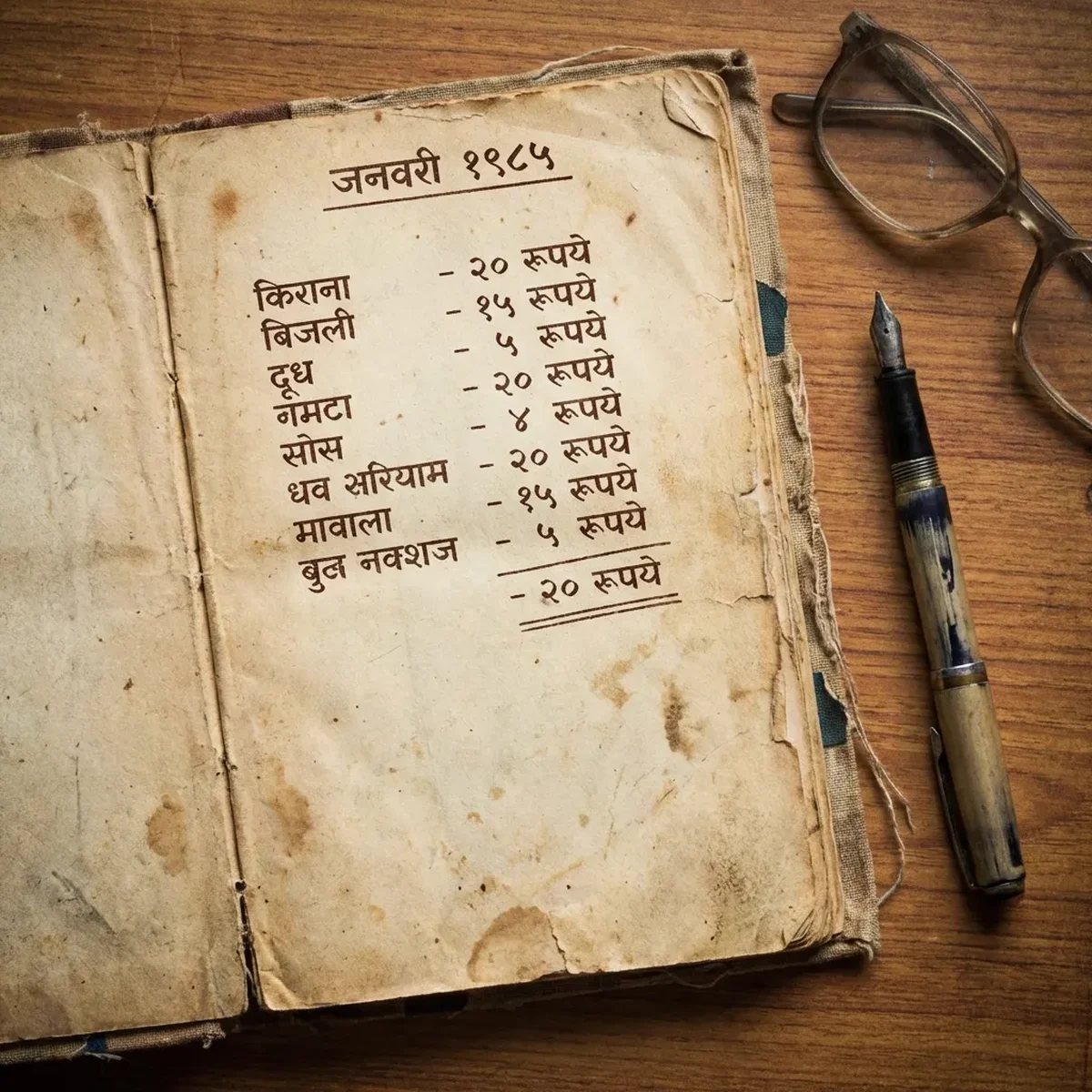
A salary slip and budget diary from decades past
Rohan: The IT Generation (2023-Present)
Rohan's story is still being written, but the opening chapters tell you everything about modern India's salary paradox.
He graduated in 2023 from IIT Hyderabad — Computer Science. Campus placement: ₹12 LPA at a well-known IT services company in Bangalore. On paper, this is the dream. IIT graduate, double-digit package, major city.
"Everyone congratulated me like I'd won the lottery," Rohan said, scrolling through his UPI transaction history. "₹1 lakh per month in hand. Let me show you where it goes."
- Rent (2BHK shared with roommate, HSR Layout): ₹15,000 (his share)
- Food (cooking + occasional ordering): ₹8,000
- EMI for education loan: ₹12,000
- Transport (metro + auto): ₹4,000
- Phone + Internet: ₹1,500
- Sending home to parents: ₹15,000
- Insurance (company doesn't cover parents): ₹3,500
- Medicines for Nana ji: ₹2,000
- Savings: ₹5,000 (SIP)
- Everything else (clothes, social, emergencies): ₹8,000
"₹1 lakh sounds like a lot," Rohan said. "But I share a room. I cook at home. I haven't bought new clothes in 6 months. I take the metro to save auto money. And I still feel broke most of the time."
When Chachu started his lecture about "spending habits," Rohan pulled up his PhonePe history. "Show me the waste, Papa. Go through it. You'll find Swiggy maybe twice a month. One movie in three months. That's my luxury budget."
The Numbers: What Three Generations Really Tell Us
Let me put this in perspective with one metric that cuts through all the noise: How many months of salary to buy a basic house?
| Generation | Salary | House Cost | Months of Salary |
|---|---|---|---|
| Nana ji (1975) | ₹1,200/month | ₹35,000 | 29 months |
| Chachu (1998) | ₹8,500/month | ₹4,50,000 | 53 months |
| Rohan (2025) | ₹1,00,000/month | ₹80,00,000 | 80 months |
Nana ji could buy a house with less than 2.5 years of salary. Chachu needed about 4.5 years. Rohan needs almost 7 years — and that's just the purchase price, without interest.
With a home loan at 8.5% for 20 years, Rohan would actually pay ₹1.4 crore for that ₹80 lakh flat. That's 140 months of his current salary. Nearly 12 years of work — just for housing.
The Comparison That Nobody Mentions
Let me show you something interesting. I ran the numbers on what each generation could actually buy with one month's salary. Not essentials — discretionary purchases. The stuff you get when you've got money left over.
Nana ji in 1975 (₹1,200 salary): After expenses, he had maybe ₹400 spare. With that, he could buy roughly 20 decent shirts, or 8 pairs of shoes, or a transistor radio (₹350), or save toward a Bajaj scooter (₹7,000, roughly 18 months of savings).
Chachu in 2000 (₹12,000 salary): After expenses, maybe ₹2,000 spare. Could buy 10-12 shirts, or 4 pairs of shoes, or a color TV (₹12,000, 6 months of savings), or save toward a Maruti 800 (₹2.5 lakh, roughly 20 months of savings).
Rohan in 2025 (₹1,00,000 salary): After expenses, maybe ₹5,000 spare on a good month. Can buy 8-10 decent shirts, or 2-3 pairs of shoes, or a mid-range phone (₹25,000, 5 months of savings), or save toward a car down payment (₹2 lakh for a ₹10 lakh car, 40 months of spare money).
See the pattern? Manufactured goods got relatively cheaper. But big assets (house, car) got relatively more expensive. And here's the kicker — you need those big assets to participate in modern life. You can't really opt out of housing in a metro. Can't raise a family on public transport in most Indian cities. The "optional" stuff became mandatory.
What Most People Get Wrong About Salary Growth
I've heard older relatives say, "these youngsters make so much but save nothing." And honestly, the youngsters think, "our grandparents could afford everything on tiny salaries, something's broken now." Both are kind of right and both are kind of wrong.
The mistake's in comparing nominal numbers. Yeah, ₹12 lakh sounds way better than ₹3,200. But inflation's nonlinear across categories. Some things inflated 50x (groceries, fuel). Some things inflated 200x (real estate, education, healthcare). And salaries inflated maybe 60-80x for comparable jobs.
From what I've seen, the real squeeze happens at the median. If you're exceptional — top 5% of earners — you're probably still ahead of inflation across all categories. If you're in the bottom 50%, you're definitely behind. The middle 45%? Depends on your specific expenses. Got kids in private school? You're struggling. No kids, renting cheaply? You're probably okay.
That variance didn't exist before. Nana ji's generation was more uniform — most government employees had similar lifestyles. Chachu's generation started diverging. Rohan's generation is all over the place. Two people with the same ₹15 LPA package can have completely different financial realities based on rent, family obligations, and whether they've got education loans.
The Psychological Toll (That Never Shows in Data)
Maybe this is the part that gets ignored in salary discussions — the mental load. Nana ji told me he never once worried about retirement. The pension system was solid. He knew exactly what he'd get. Healthcare was covered. Housing was either owned or provided.
Chachu worried, but manageable amounts. Pension was still there, though not as generous. Some planning required, but the path was clear.
Rohan? He's 24 and already obsessing about retirement corpus calculations. "I need ₹5 crore by age 60," he told me once. "That means ₹50,000 SIP monthly from age 30 assuming 12% returns. What if returns are only 10%? What if I lose my job at 45? What if AI replaces programmers?"
The uncertainty's probably the real inflation. Not sure if that makes sense, but it feels true. You're earning more but planning for way more variables. Every decision's a calculated risk. Nothing's guaranteed. That anxiety has a cost that doesn't show up in salary comparisons.
What Changed? Our Family's Theory
Phase 1: Nehruvian India (1950s-1990)
Nana ji's India was poor but predictable. Government jobs were the gold standard. Salaries were low, but so were prices. The "license raj" controlled everything — which kept prices stable but also kept the economy growing slowly.
"We didn't have choices," Nana ji said. "One type of soap. One type of oil. Doordarshan only. But hum aaram se the. Kisi ko kuch tension nahi tha."
Phase 2: Liberalization Era (1991-2010)
Chachu's generation rode the liberalization wave. Choice exploded. Consumer goods flooded in. IT sector created entirely new salary brackets. But the old support systems — government housing, free healthcare, subsidized canteens — started disappearing.
"My generation had higher salaries and higher stress," Chachu admitted. "Papa never worried about which school to pick, which insurance to buy, whether to invest in equity or FD. We had to figure all of that out — and the wrong choice could set you back years."
Phase 3: The New Economy (2010-Present)
Rohan's India is the most prosperous on paper and the most anxious in reality. IT packages that would've been unimaginable in 1990 get eaten alive by metro city costs. Education requires loans. Healthcare requires insurance. Retirement requires SIPs. Everything requires planning, and the margin for error is razor-thin.
"Nana ji could be average and live well," Rohan observed. "Papa had to be above average. My generation has to be exceptional just to afford what was normal for them."
The Sector Gap (That's Getting Worse)
Here's something that came up during the dinner argument. Rohan's making ₹12 LPA in IT. His friend from the same IIT batch joined the civil services — starting salary roughly ₹56,000 per month (₹6.7 LPA). Almost half of Rohan's package.
But here's the thing — that IAS officer gets a government flat in Delhi for maybe ₹5,000 rent. Full medical coverage for family. Vehicle allowance. Travel allowance. LTC. Pension. When you add it all up, the real compensation gap's probably smaller than the salary gap suggests.
Nana ji's time, government vs private gap was small. Maybe 10-20% difference. Chachu's time, it grew to maybe 50-100% difference for comparable skills. Today? Private sector IT can pay 3-5x what government pays for the same engineering degree. But government provides stability and benefits that private doesn't.
From what I've seen, this creates two Indias. One that's chasing high salaries with high costs and high stress. Another that's taking lower salaries with lower costs and lower stress. Not sure which one's actually better off. Honestly depends on what you value — money now or peace of mind.
The Women's Story (That's Often Missing)
My Nani never worked outside the home. That was normal for her generation. Chachi's a teacher — dual income was necessary but manageable. Rohan's girlfriend's a consultant at Deloitte, makes roughly the same as him. They're planning to marry next year, and the dual-income's not optional — it's barely enough for two people.
When I talked to Chachi about this, she had interesting perspective. "My mother-in-law managed a household on one income. I couldn't. My daughter-in-law won't be able to even with two incomes unless they're both high earners. Each generation needs more money for the same lifestyle."
The flip side's that women's workforce participation and earning power has grown, which is progress. But it's also become economically necessary rather than optional for most families. Maybe that's a mixed blessing. More independence, but also more pressure.
The Lesson I Took Away
After dinner, Nana ji called me aside. "Beta, write this down somewhere. Each generation earns more but keeps less. The numbers go up, but the peace goes down. That's the real inflation — not just prices, but anxiety."
He was right. Nominal wages in India have grown roughly 50-60x since the 1970s. But housing has grown 200x. Education 1,000x. Healthcare 500x. The headline salary looks impressive. The purchasing power tells a different story.
If you're Rohan's age — working hard, saving what you can, wondering why it doesn't feel like enough — know this: it's not you. The math genuinely changed. Your grandparents aren't lying about the good old days. And you're not lazy for struggling with a salary that would've been unimaginable a generation ago.
Document your story. Thirty years from now, your grandchildren will find it unbelievable that ₹12 lakh per annum wasn't enough to buy a house.
What Can You Actually Do About It?
I asked all three generations this question. Here's what they said.
Nana ji's advice: "Save first, spend later. We bought nothing on credit except the house. That discipline built wealth slowly but surely. Today's youngsters want everything immediately. EMI culture's dangerous."
Chachu's advice: "Invest in equity early. I started too late. If I'd put ₹5,000 monthly in a mutual fund SIP from 1992, I'd have maybe ₹2 crore today. I waited until 2005. Lost 13 years of compounding. Don't make that mistake."
Rohan's perspective: "The old advice doesn't fully work anymore. Can't buy a house with cash. Can't avoid EMIs. Can't rely on government pension. Have to figure out a middle path — save aggressively but also live now. Not sure I've got it figured out, honestly. But I'm trying to max my SIP while also not being miserable in my 20s."
From what I can tell, all three are probably right for their times. The strategy that worked in 1970 won't work in 2025. But some principles seem universal — spend less than you earn, invest the difference, don't take on bad debt, and plan for a future that's uncertain. That last part's maybe the hardest one now.