
Remember when you got your first salary? ₹25,000/month felt like you'd conquered the world. Maggi for dinner, sharing a 2BHK with a roommate, and that ₹200 dosa on the weekend felt like a splurge. You saved ₹8,000-10,000 every month without even trying.
Fast forward 5 years. You're earning ₹75,000/month — triple the salary. But somehow, your savings are still ₹8,000-10,000. Sometimes less. Where did ₹50,000 of "extra" income disappear?
Welcome to lifestyle inflation — the silent wealth killer that steals your raises before you even notice.
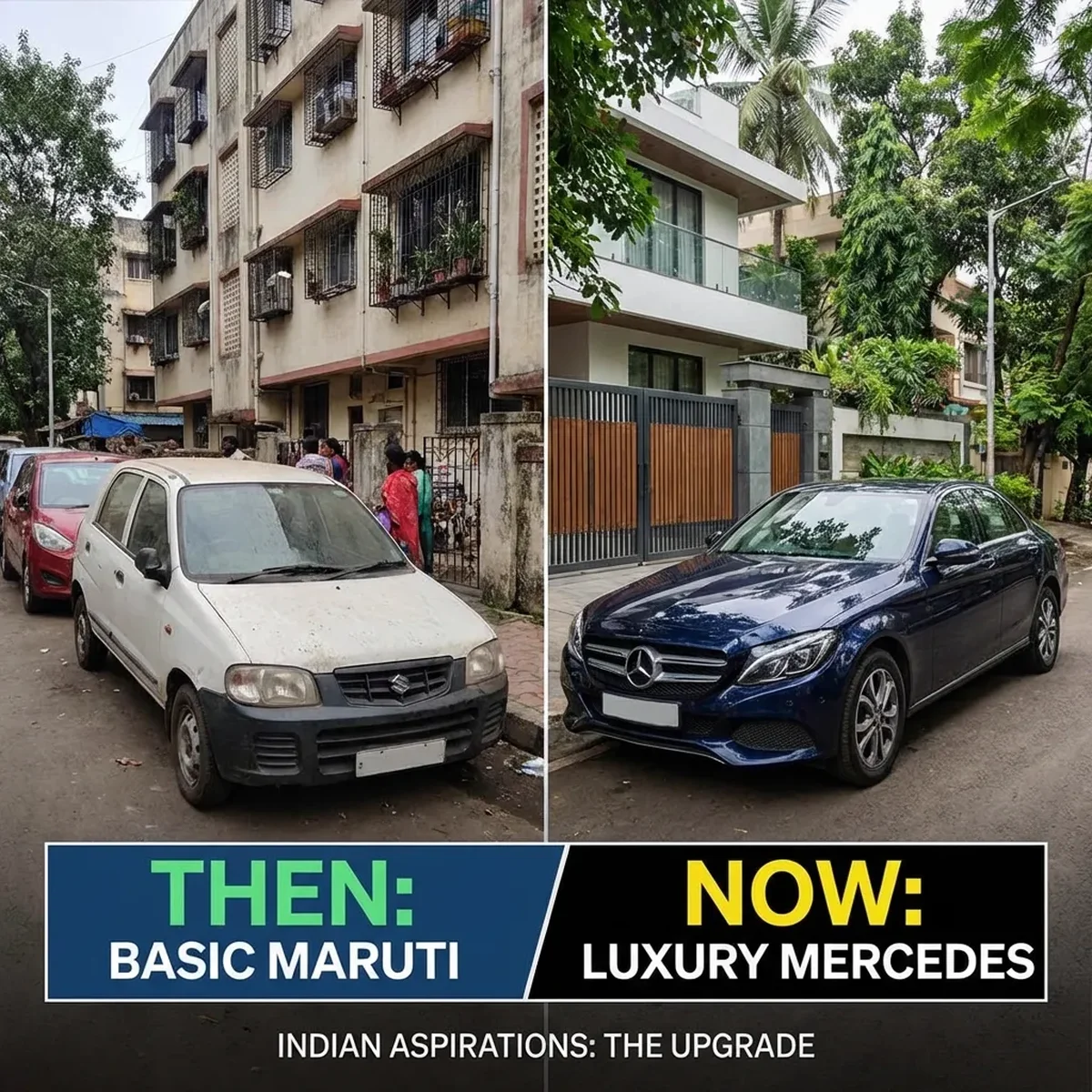
From Maruti to Mercedes — each upgrade feels "deserved" but compounds into a massive wealth gap over time
The Anatomy of Lifestyle Creep: Where Your Salary Goes
Let's trace a typical Indian professional's spending journey as their salary grows from ₹30,000 to ₹1,50,000 over 8-10 years:
| Expense Category | ₹30K/month (Fresher) | ₹75K/month (5 yrs exp) | ₹1.5L/month (10 yrs exp) |
|---|---|---|---|
| Housing | ₹7,000 (shared PG) | ₹20,000 (1BHK alone) | ₹45,000 (2BHK + gated community) |
| Food | ₹4,000 (mess + Maggi) | ₹12,000 (Swiggy + dining out) | ₹25,000 (organic groceries + fine dining) |
| Transport | ₹1,500 (bus + auto) | ₹6,000 (Ola/Uber daily) | ₹18,000 (car EMI + fuel + parking) |
| Shopping/Clothing | ₹1,000 | ₹5,000 | ₹15,000 |
| Subscriptions | ₹200 (shared Netflix) | ₹2,000 (Netflix, Spotify, gym) | ₹5,000 (premium everything) |
| Socializing | ₹2,000 | ₹8,000 | ₹18,000 |
| Total Expense | ₹15,700 | ₹53,000 | ₹1,26,000 |
| Savings | ₹14,300 (48%) | ₹22,000 (29%) | ₹24,000 (16%) |
Salary increased 5x from ₹30K to ₹1.5L. Expenses increased 8x from ₹15.7K to ₹1.26L. Savings rate dropped from 48% to 16% despite earning 5 times more. That's lifestyle inflation in action.
What Most People Get Wrong About Lifestyle Inflation
I think the most common misconception is that lifestyle inflation is about being bad with money. It's not. From what I've seen, some of the smartest people I know — engineers at top companies, doctors with their own practices, CA firm partners — fall into exactly this trap. The issue isn't intelligence or financial literacy. It's that each individual spending decision seems perfectly reasonable. Nobody wakes up and says, "I'm going to waste ₹50,000 today." Instead, it's ₹200 here on a better coffee, ₹5,000 there on a nicer restaurant, ₹3,000 on a subscription you'll use twice. Each one makes sense in isolation. The problem is they compound, and nobody tracks the total. Honestly, I think the real villain isn't the spending — it's the absence of tracking. If you showed most people a clear spreadsheet of every rupee they'd spent in the last 12 months, categorized and totaled, they'd probably be shocked at how much went to things that didn't actually make them happier.
The Psychology: Why We Can't Stop Upgrading
Lifestyle inflation isn't about being irresponsible. It's rooted in deeply human (and very Indian) psychological patterns:
1. The "I Deserve It" Trap
You worked hard for that promotion. 60-hour weeks. Weekend calls. Surely you DESERVE that ₹15,000 leather jacket? That weekend Goa trip? That ₹60 lakh car? Each individual purchase feels justified. But collectively, they erase your entire raise.
2. Social Comparison (The Neighbor's Car Problem)
Your colleague bought a Creta. Now your WagonR feels inadequate. Your school friend's Instagram shows Bali vacations. Suddenly your Lonavala trip seems "basic." In India, social comparison is turbocharged by family gatherings where relatives compare everything — from your car to your AC brand.
3. Hedonic Adaptation
The first Uber ride felt luxurious. After 100 rides, it's just transportation. The first Swiggy order was exciting. After 500, it's default dinner. Every upgrade feels amazing for 2-3 weeks, then becomes the new normal. You need the NEXT upgrade to feel that excitement again.
4. Lifestyle Lock-In
Once you move to a ₹45,000 apartment, you can't easily move back to ₹20,000. Once your family gets used to dining out twice a week, cutting back feels like "going backward." Lifestyle creep is a one-way ratchet — it's socially and psychologically very hard to downgrade.
I've noticed this lock-in effect is especially strong with housing and transportation — the two biggest expense categories. A friend of mine moved from a ₹15,000 apartment in Koramangala to a ₹38,000 gated community in Sarjapur Road when he got a big promotion. Three years later, his startup didn't work out and he took a 40% pay cut. Could he move back to a ₹15,000 place? In theory, yes. But his kids were in a school near the gated community, his wife had built a social circle there, and they'd furnished the place with ₹4 lakh of modular kitchen and custom wardrobes. Moving would mean losing the deposit, the furniture investment, disrupting the kids' school — probably ₹3-4 lakh in total switching costs. So he stayed and cut everything else instead: no vacations, no new clothes, eating dal-chawal every day. The apartment locked him in, and everything else suffered. Maybe the lesson is to be extra cautious with housing upgrades specifically, because they're the hardest to reverse.

The Starbucks effect — ₹450 coffee feels normal when you earn ₹1.5 lakh, but 12 cups/month is ₹5,400/year
The Real Cost: What Lifestyle Inflation Takes From Your Future
Let's do the math on what those "small upgrades" cost you over 20 years:
| Monthly "Upgrade" | Cost/Month | 20-Year Cost (@ 12% SIP returns) |
|---|---|---|
| Switching from home food to Swiggy daily | ₹8,000 | ₹79 lakh |
| Car EMI vs. using public transport | ₹15,000 | ₹1.49 crore |
| Upgrading flat (₹20K to ₹45K rent) | ₹25,000 | ₹2.48 crore |
| Premium subscriptions + gym | ₹3,000 | ₹30 lakh |
| Total Monthly Lifestyle Upgrades | ₹51,000 | ₹5.06 crore |
₹5 crore. That's the 20-year opportunity cost of "normal" lifestyle inflation for someone earning ₹1.5 lakh/month. You'd have enough for early retirement at 45 instead of working till 60. But instead, you have... a slightly nicer apartment and a car that depreciates 10% every year.
Why Earning More Doesn't Fix It
Probably the biggest lie we tell ourselves about money: "When I earn more, I'll save more." I definitely believed this through my 20s. Got a 40% raise at 26, was convinced I'd start saving seriously. Didn't happen. The raise got absorbed by a nicer flat, eating out more often, and a gym membership I used for three months. Data says this pattern is roughly universal:
| Income Bracket (Annual) | Average Savings Rate | When They'll Have ₹1 Crore |
|---|---|---|
| ₹5-10 LPA | 15-20% | 22-25 years (if invested) |
| ₹10-20 LPA | 12-18% | 18-22 years |
| ₹20-40 LPA | 10-15% | 12-16 years |
| ₹40+ LPA | 8-12% | 8-12 years |
Notice the savings RATE drops as income increases. People earning ₹40 LPA save a smaller percentage than those earning ₹10 LPA. More income = more lifestyle = less savings rate. The absolute savings may be higher, but the efficiency drops dramatically.

The transport upgrade — from ₹50 auto rides to ₹500 Uber cabs, a 10x increase that feels "normal"
The Indian Milestone Trap: Marriage, Kids, and Family Pressure
In India, lifestyle inflation isn't just about personal choices. It's turbocharged by culturally expected milestones that come with massive spending jumps:
- Marriage: The average Indian wedding costs ₹15-30 lakh for a middle-class family. Many take loans. Some dip into their emergency fund. The wedding itself is just the start — a new household needs furniture, appliances, "matching" decor. Suddenly your monthly expenses jump ₹20-30,000.
- First Baby: Hospital delivery (₹1-3 lakh for normal, ₹3-6 lakh for C-section in a private hospital), baby gear, diapers, formula, pediatrician visits. Your monthly spend increases ₹10-15,000 immediately, growing to ₹20-30,000 within 2 years when daycare/preschool begins.
- The "Settle Down" Flat: EMIs of ₹30,000-60,000 replace rent of ₹15,000-25,000. Registration, interior, modular kitchen, society maintenance — your monthly housing outgo doubles or triples.
- Parents' Health: As parents age, medical expenses land on your plate. Health insurance premiums for 60+ parents run ₹25,000-50,000/year. Uninsured procedures can wipe out entire emergency funds. I've seen families go from comfortable to financially strained in a single hospitalization — one cardiac event and ₹8-10 lakh disappears overnight.
Each milestone is "necessary" and emotionally non-negotiable. That's what makes the Indian financial journey uniquely challenging — you can't simply say "no" to a wedding or a baby to save money. The trick is PLANNING for these milestones years in advance.
Case Study: Arjun vs. Priya (Both Earn ₹1.2 LPA)
Arjun upgrades his lifestyle with every raise. At 35, he has a ₹60 lakh car loan, ₹80 lakh home loan, ₹15,000/month on dining out, premium gym membership, and annual international holidays. Total monthly obligations: ₹1,05,000. Savings: ₹15,000/month. Net worth at 35: ₹25 lakh (mostly locked in flat equity).
Priya kept her lifestyle at the ₹60K/month level even as salary grew. She drives a ₹8 lakh car (paid cash), lives in a rented 1BHK (₹18,000), cooks 5 days a week. Every raise went 70% to investments. Monthly SIP: ₹50,000. Net worth at 35: ₹1.2 crore (liquid, growing at 12-15% annually).
Same salary. Same city. Same age. ₹95 lakh difference in net worth. By 45, Arjun will have ₹80 lakh. Priya will have ₹4.5 crore. By 50, Priya can retire. Arjun will still have EMIs running.
Now, before you dismiss Arjun as reckless — he's not. He's doing what roughly 80% of urban Indian professionals do. And here's the uncomfortable truth that I think gets lost in these comparisons: Arjun is probably having more fun right now. His apartment is nicer, his car is more comfortable, his vacations are better. Priya's approach requires saying "no" to things your friends are doing, living below your means in a culture that judges you by visible markers of success, and trusting that a number on a screen (your portfolio) will someday matter more than the car in your parking spot. That's a hard sell, especially when you're 28 and retirement feels like science fiction. Seems like the real trade-off isn't financial — it's psychological. You're trading today's social status and comfort for tomorrow's freedom. Not sure there's a universally "right" answer here, but I know which side the math falls on, and it's not Arjun's.
From what I've seen, the people who actually beat lifestyle inflation don't rely on willpower. They set up systems. One couple I know in Hyderabad has a rule: any raise or bonus gets automatically split — 60% goes to a separate investment account via SIP, and only 40% enters their main spending account. They don't even see the 60%. It's like paying a tax to your future self. Over 8 years of this approach, they've built roughly ₹1.1 crore in investments while still slowly upgrading their lifestyle with that 40%. Their friends earning the same salary have maybe ₹20-30 lakh. The difference? Automation. They removed the decision from the equation, so there's no monthly temptation to "just skip the SIP this month." I think that's probably the most practical advice in this entire article — don't fight lifestyle inflation with discipline, fight it with automation.
A Budget That Actually Works in India
I've tried a bunch of budgeting frameworks over the years. Most of them are designed for American salaries and don't map well to Indian financial realities (they assume no parental financial support obligations, for instance). Here's what I've adapted to work with Indian incomes, and honestly, it's not perfect — but it's the closest thing to a system that doesn't fall apart after two months:
- 50% — Needs: Rent, groceries, utilities, insurance, EMIs. These are non-negotiable. Cap these firmly even when salary increases.
- 30% — Savings & Investments: SIPs, PPF, NPS, emergency fund. THIS should increase when your salary increases. Not your lifestyle.
- 20% — Wants: Dining out, shopping, vacations, subscriptions. This is your lifestyle budget. Cap it.
The key: when you get a raise, allocate 50% of the raise to savings and only 50% to lifestyle. Got a ₹20,000 raise? Increase SIP by ₹10,000, increase lifestyle by ₹10,000. This way you improve your life AND your wealth simultaneously.
5 Rules That Actually Work
- The 72-Hour Rule: Want to buy something over ₹5,000? Wait 72 hours. If you still want it after 3 days, buy it. 60% of impulse purchases fail this test.
- Automate Before You Spend: Set up SIPs on salary day. Before you even see the money, ₹30-50K goes to investments. You can't spend what you don't see.
- The Lifestyle Cap: Set a total lifestyle budget (wants + socializing) and don't increase it more than once a year, regardless of raises.
- Track Every Rupee for 3 Months: Use an app like Moneycontrol or even a simple spreadsheet. Most people have NO idea where 30% of their salary goes. Tracking creates awareness.
- Find Your "Enough" Number: Define what lifestyle makes you genuinely happy. Is it ₹50K/month or ₹3 lakh/month? Everything above that number should go to investments. The answer might surprise you — happiness research shows minimal difference in satisfaction above ₹1.2 lakh/month in Indian metros.
If there's one thing I'd want someone in their mid-20s to take away from all of this, it's probably this: lifestyle inflation isn't about being bad with money. Most people experiencing it are smart, hardworking, and well-intentioned. They just never set up the systems to protect themselves from their own future spending impulses. The automation approach — routing money to investments before it hits your spending account — works because it takes willpower out of the equation entirely. And honestly, that's the only approach I've seen work consistently over 5+ years.
Use our Inflation Calculator to see how much your lifestyle costs will grow over time — and our Retirement Calculator to see how much sooner you can retire by controlling lifestyle inflation.