Every February, India runs on one question: "Kitna tax bacha?" Whether you're a fresh graduate filing your first ITR or a seasoned professional trying to maximize deductions — the Indian tax system is a maze designed to confuse you into paying more than you should.
But here's the thing: the Indian Income Tax Act has over 70 deductions and exemptions built into it. Most salaried professionals use barely 3-4 of them. You're literally leaving money on the table because nobody taught you how to read a Form 16.
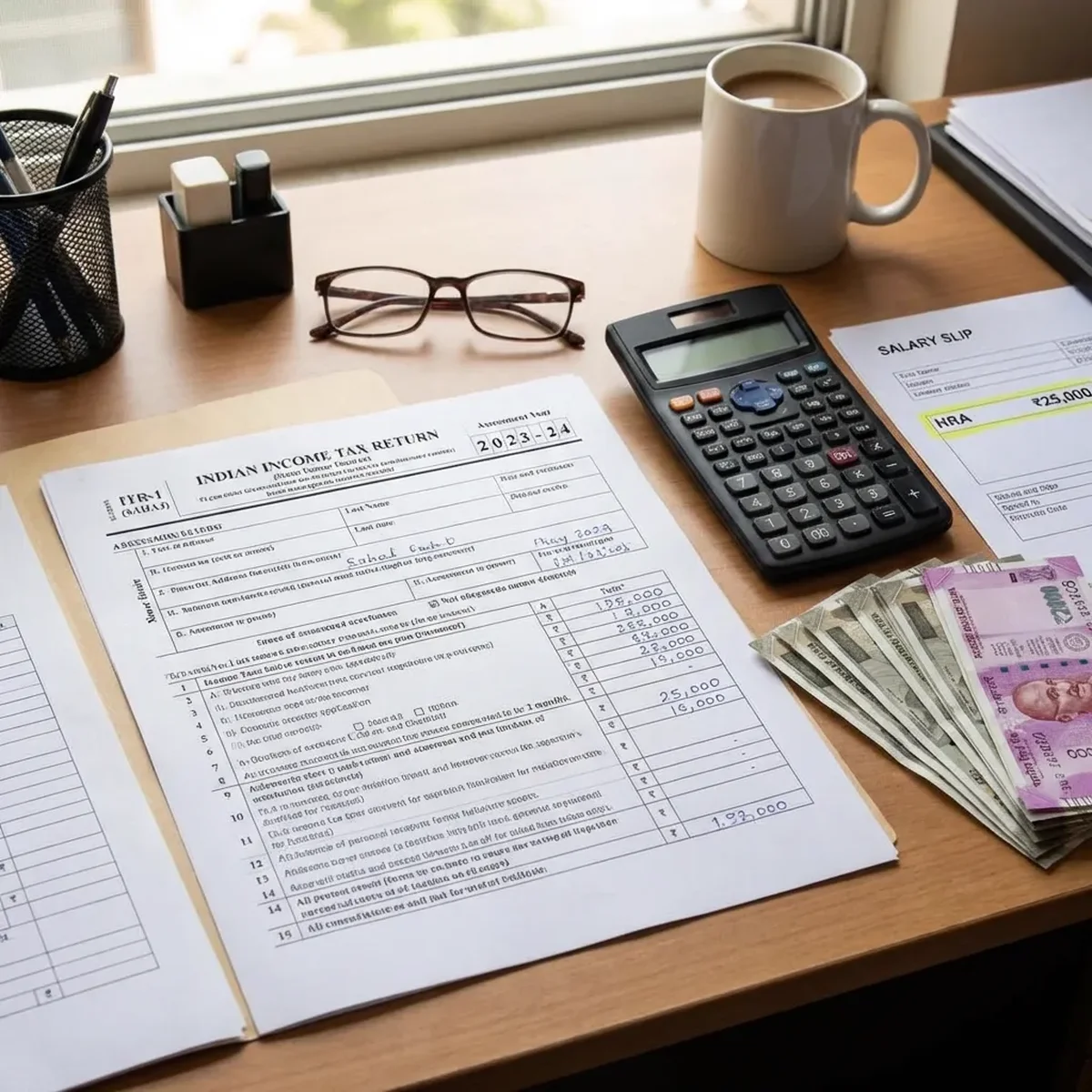
The annual ritual — every January, India's salaried class scrambles for investment proofs
Old Regime vs. New Regime: The Complete Comparison
Since FY 2023-24, the New Tax Regime is the DEFAULT. If you don't directly choose the Old Regime, you'll be taxed under the new one. Here's how they compare:
| Income Slab | Old Regime Tax Rate | New Regime Tax Rate (FY 2024-25) |
|---|---|---|
| Up to ₹3 lakh | Nil | Nil |
| ₹3-6 lakh | 5% | 5% |
| ₹6-9 lakh | 20% | 10% |
| ₹9-12 lakh | 20% | 15% |
| ₹12-15 lakh | 30% | 20% |
| Above ₹15 lakh | 30% | 30% |
The New Regime looks cheaper, right? But here's the catch: you lose almost ALL deductions — 80C, 80D, HRA exemption, LTA, home loan interest (Section 24). The only deduction allowed is ₹75,000 standard deduction.
What Most People Get Wrong About Choosing a Tax Regime
I think the biggest mistake people make is choosing a regime based on vibes rather than actual math. From what I've seen, there's this widespread belief that the New Regime is "always better because the slabs are lower." But that's probably only true if you aren't claiming many deductions — and honestly, most salaried Indians in metros with rent, insurance, and even basic EPF are already sitting on ₹3-4 lakh in deductions without trying very hard. Here's a quick way to think about it: if your total deductions cross roughly ₹3.75 lakh, the Old Regime almost certainly wins. Below ₹2 lakh in deductions, the New Regime is the smarter pick. The tricky zone is between ₹2-3.75 lakh — and that's where you really need to sit down with a spreadsheet or a CA.
Let me give you a concrete comparison. Take two people both earning ₹12 LPA. Person A rents in Mumbai, pays ₹20,000/month rent, has EPF, and invests ₹50,000 in ELSS — their deductions probably add up to around ₹3.5 lakh. Person B lives with family, no rent, no investments beyond EPF — maybe ₹1.2 lakh in deductions total. Person A saves roughly ₹35,000-40,000 more under the Old Regime. Person B saves about ₹25,000 more under the New Regime. Same salary, wildly different outcomes. It seems like the regime choice is less about your income and more about your life situation — where you live, whether you rent, and how disciplined you are about investing. Hard to say which is "better" without knowing those details.
Understanding HRA: The Biggest Tax Saver for Renters
If you're renting and on the Old Regime, HRA (House Rent Allowance) is your single biggest tax weapon. But most people don't know how to calculate it properly.
HRA exemption is the MINIMUM of these three amounts:
- Actual HRA received from your employer
- 50% of basic salary (metro cities) or 40% (non-metro)
- Rent paid minus 10% of basic salary
Let me show you with a real example. My friend Priya works in Bangalore:
| Component | Amount |
|---|---|
| Basic Salary | ₹6,00,000/year |
| HRA Received | ₹3,00,000/year |
| Rent Paid | ₹25,000/month = ₹3,00,000/year |
Calculation:
- Actual HRA = ₹3,00,000
- 50% of Basic (Bangalore = metro) = ₹3,00,000
- Rent - 10% of Basic = ₹3,00,000 - ₹60,000 = ₹2,40,000
Minimum = ₹2,40,000. That's the HRA exemption. On the 30% tax bracket, this saves her ₹72,000 + cess in tax. Just from HRA alone.
Section 80C: The ₹1.5 Lakh Shield
This is the most popular deduction and most people know about it. But they don't optimize it. Section 80C allows up to ₹1,50,000 deduction across several instruments:
| Instrument | Lock-in | Returns | Best For |
|---|---|---|---|
| PPF | 15 years | 7.1% (tax-free) | Conservative investors |
| ELSS Mutual Funds | 3 years | 12-15% (historical avg) | Growth seekers |
| NPS (Tier-I) | Till 60 | 10-12% | Retirement planning |
| EPF (Employee PF) | Till retirement | 8.15% | Auto-deducted from salary |
| Life Insurance Premium | Policy term | 4-6% | Only term plans recommended |
| Home Loan Principal | N/A | N/A | If you have a home loan |
| Children's Tuition Fees | N/A | N/A | Max 2 children |
Common mistake: people buy expensive LIC endowment plans (returns 4-5%) just for 80C. Don't. Buy a term insurance for ₹1 crore cover (costs ₹8,000-15,000/year) and invest the rest in ELSS or PPF. You get better returns AND the tax deduction.
I've noticed that people rarely do the math on how much this endowment-vs-ELSS decision actually costs them over time. Let's say you're 28 and you put ₹1.5 lakh per year into a LIC Jeevan Anand policy. After 20 years, at roughly 5% return, you'd have maybe ₹52-55 lakh. Now take that same ₹1.5 lakh into an ELSS fund returning 12% historically — you're looking at ₹1.15 crore. That's a difference of ₹60+ lakh over a working lifetime, and both gave you the same 80C deduction. The opportunity cost of choosing the wrong 80C instrument is probably the single most expensive financial mistake middle-class Indians make, and it's not even close. I think a lot of this happens because LIC agents are everywhere and ELSS doesn't have door-to-door salespeople.
There's another angle most people miss: your EPF contribution already counts toward 80C. If your basic salary is ₹50,000/month, your EPF contribution alone is ₹72,000/year — that's nearly half the 80C limit gone before you've invested a single extra rupee. So you really only need to find ₹78,000 more to max out 80C. Maybe that's a PPF SIP of ₹6,500/month, or an ELSS SIP of the same amount. Not sure why so many people panic about "filling up 80C" when their EPF is already doing a lot of the heavy lifting. It seems like the real challenge isn't finding ₹1.5 lakh — it's making sure you're not double-counting or putting money into poor instruments just to hit the limit.
Planning your tax deductions — the smartest financial decision of the year
Beyond 80C: Deductions Most People Miss
Section 80D — Health Insurance (₹25,000-₹1,00,000)
Premium for yourself: ₹25,000 deduction. Premium for senior citizen parents: additional ₹50,000. If both you and your parents are senior citizens: up to ₹1,00,000 total. Most people forget to claim their parents' insurance premium as a deduction.
Section 80CCD(1B) — NPS Extra (₹50,000)
This is OVER AND ABOVE the ₹1.5 lakh 80C limit. Invest ₹50,000 in NPS Tier-I and get an additional ₹50,000 deduction. At 30% tax bracket, that's ₹15,000 saved with one investment.
Section 80E — Education Loan Interest (No limit)
If you took an education loan, the ENTIRE interest paid is deductible. No upper limit. This applies for up to 8 years from the start of repayment. Many people don't know this one.
Section 80TTA/80TTB — Savings Account Interest
Up to ₹10,000 interest on savings accounts is tax-free (Section 80TTA). For senior citizens, up to ₹50,000 on FD and savings interest is exempt under Section 80TTB.
Section 24(b) — Home Loan Interest (₹2,00,000)
If you have a home loan for a self-occupied property, up to ₹2 lakh of interest paid is deductible. For let-out properties, there's no upper limit on interest deduction (but the overall loss from house property is capped at ₹2 lakh).
A lot of people I know who bought flats specifically mention the 24(b) deduction as a reason. And yes, ₹2 lakh is a meaningful deduction. But here's where I think the math gets tricky — that ₹2 lakh deduction saves you maybe ₹60,000-₹70,000 in taxes (at the 30% slab). Meanwhile, you're paying ₹4-6 lakh in actual interest on the loan. So you're spending ₹4-6 lakh to save ₹60-70K. That's probably not a great trade on its own. The home loan deduction makes an already decent investment slightly better — it shouldn't be the reason you buy property in the first place. I've seen too many people convince themselves that the tax benefit alone justifies a home purchase. It doesn't, not by a long shot.
The Case Study: ₹15 LPA Salary — How Much Can You Actually Save?
Let's take a realistic example. Vikram earns ₹15 LPA (take-home ₹1.2 lakh/month), lives in Bangalore, rents a flat, and his parents are senior citizens:
| Deduction | Section | Amount |
|---|---|---|
| Standard Deduction | — | ₹50,000 |
| EPF (Employee Share) | 80C | ₹72,000 |
| PPF | 80C | ₹78,000 |
| NPS (Extra) | 80CCD(1B) | ₹50,000 |
| Health Insurance (Self + Parents) | 80D | ₹75,000 |
| HRA Exemption | 10(13A) | ₹2,40,000 |
| Total Deductions | ₹5,65,000 |
His taxable income drops from ₹15,00,000 to ₹9,35,000. Under the Old Regime, his tax is approximately ₹87,000. Under the New Regime (no deductions), his tax on ₹15,00,000 would be approximately ₹1,50,000. The Old Regime saves him ₹63,000 per year.

The power of proper tax planning — every rupee saved on tax is a rupee invested
When to Plan (Not in March)
Most people wait until January to scramble for investment proofs and tax-saving investments. That's probably the worst possible time — you're rushed, you make poor choices, and you end up buying whatever LIC or insurance product your company's HR team pushes. I've done this. Bought a ULIP in March panic once. Worst financial decision I ever made, honestly. The smart approach is to set things up in April and forget about them:
- April-May: Set up SIP for ELSS and PPF. Start NPS contributions. Choose your regime for the year.
- June-July: File previous year's ITR. Verify Form 26AS matches your TDS.
- September: Review your investments mid-year. Top up PPF/ELSS if needed.
- November: Renew health insurance. Submit investment declaration to employer.
- January-February: Submit proofs to HR. Last chance for 80C investments.
- March: Complete any remaining investments before March 31 deadline.
Common Tax Mistakes That Cost You Money
- Not claiming HRA while paying rent to parents: Yes, you can pay rent to your parents and claim HRA. They report it as income, but if they're in a lower bracket, the family saves net tax.
- Ignoring employer NPS contribution: Your employer's NPS contribution (up to 10% of basic) is deductible under 80CCD(2) — this is SEPARATE from the ₹1.5L + ₹50K limits. Free money!
- Not switching regimes: Salaried individuals can switch between old and new regime every year. Run the numbers both ways before choosing.
- Missing deadline for revised returns: Made a mistake? You can file a revised return within 2 years of the assessment year end.
Special Case: Freelancers and Gig Workers
The gig economy is exploding in India — from Swiggy delivery partners to freelance IT consultants. If you earn income outside a traditional salary, tax planning is completely different (and more important):
- No employer TDS safety net: Unlike salaried employees who get tax automatically deducted, freelancers must calculate and pay their own taxes. Miss advance tax deadlines and you'll get hit with interest under Section 234B and 234C.
- Advance tax is mandatory: If your annual tax liability exceeds ₹10,000, you MUST pay advance tax in quarterly installments (June 15, September 15, December 15, March 15). Missing these means interest penalties of 1% per month.
- Section 44ADA presumptive taxation: If your freelance income is under ₹75 lakh (increased from ₹50 lakh), you can use the presumptive scheme — declare 50% of gross receipts as income and skip maintaining books. This is a massive simplification that most freelancers miss.
- Deductible business expenses: Unlike salaried employees, freelancers can deduct legitimate business expenses — internet bills, laptop depreciation, co-working space rent, software subscriptions, travel for client meetings. Keep every receipt. Good record-keeping can reduce your taxable income by 30-50%.
- GST registration: If your freelance turnover exceeds ₹20 lakh (₹10 lakh for special category states), GST registration is mandatory. Below that threshold, it's still worth registering voluntarily if your clients are businesses — they get input credit on your invoices, making you more attractive as a vendor.
For freelancers earning ₹10-30 LPA, proper tax planning (including 44ADA, business expense claims, and strategic investments) can reduce effective tax rate from 25-30% to 12-18%. That's ₹1-3 lakh saved annually — money that should go straight into SIPs.
From what I've seen talking to freelancers and gig workers, the single most common regret is not maintaining proper records in the first year. Someone I know — a freelance UI designer earning around ₹18 LPA — didn't keep track of software subscriptions, Figma licenses, cloud hosting costs, or even the laptop she bought for work. She ended up paying tax on the full ₹18 lakh instead of claiming maybe ₹3-4 lakh in legitimate business expenses. That's roughly ₹90,000-₹1,20,000 in tax she didn't need to pay. It's honestly painful to watch. The fix is simple: open a separate bank account for business income, get a basic accounting app like Zoho Books or even a Google Sheet, and log every business expense as it happens. Maybe spend 15 minutes every Sunday categorizing the week's expenses. It's not glamorous work, but it's probably the highest-ROI 15 minutes you'll spend all week.
Use our Inflation Calculator to see how inflation erodes your tax refund — and why investing it immediately matters more than you think.