
My cousin Priya moved from Bangalore to San Francisco in 2019 for a tech job paying 4x her Indian salary. "I'm rich now," she told the family WhatsApp group, with a selfie from the Golden Gate Bridge. Within three months, she was sharing a cramped apartment with three roommates, eating dal-chawal she cooked because restaurants were ₹2,000+ per meal, and wondering where her "giant" paycheck was disappearing.
Meanwhile, my college friend Rahul quit his ₹15 LPA TCS job and moved to Lisbon, Portugal as a freelance developer. Indian relatives were horrified. "Career kharab kar raha hai!" But three years later, Rahul owns a two-bedroom apartment in a historic neighbourhood. In Bangalore, the same salary would've covered rent and groceries. In Lisbon, he owns property.
These stories capture something that CPI numbers can't: money feels completely different depending on where you spend it. This tutorial explores how inflation and purchasing power work across the world — told from an Indian perspective, because that's the lens most useful to us.
Chapter 1: The Great Indian Divergence (Before We Go Global)
Before comparing India to the world, let's acknowledge something most Indians don't fully appreciate: India's own internal cost-of-living differences are wild.
| Expense | Varanasi | Pune | Bangalore | Mumbai |
|---|---|---|---|---|
| 1 BHK Rent | ₹5,000 | ₹12,000 | ₹18,000 | ₹28,000 |
| Thali meal (restaurant) | ₹60 | ₹120 | ₹150 | ₹180 |
| Auto (5 km) | ₹30 | ₹80 | ₹120 | ₹100 |
| Monthly groceries (couple) | ₹4,000 | ₹7,000 | ₹9,000 | ₹11,000 |
A software engineer earning ₹12 LPA in Varanasi lives like royalty — house, car, domestic help, savings. The same ₹12 LPA in Mumbai means a shared flat in Andheri and careful budgeting. Same country, same currency, completely different life.
This is why "average inflation" numbers are misleading. India's official CPI might say 5-6%, but food inflation in rural UP might be 9% while rent inflation in Bangalore's Whitefield is 15%. Your personal inflation rate depends entirely on where you live and what you spend on.
I think this is probably the most important point in this entire tutorial, and it's something that most people — including financial planners — get wrong. When someone says "India's inflation is 5.7%," that number is an average across hundreds of cities and thousands of goods. Your personal inflation could easily be 3% or 12% depending on your spending pattern. If you're a young professional in Bangalore spending heavily on rent, Swiggy, and Uber, your actual cost increase is probably closer to 10-12% annually because those categories have been inflating way faster than the CPI basket. If you're a retiree in a small town who owns their home and mostly buys groceries, maybe 4-5%. From what I've seen, nobody tracks their personal inflation rate, and that's a shame because it would change how you plan your investments. You shouldn't be targeting "inflation + 2%" returns — you should be targeting "your inflation + 2%."
Chapter 2: The Gulf Dream — India's Biggest Expat Story
No article about Indians and global money is complete without the Gulf story. Over 9 million Indians live in GCC countries — UAE, Saudi Arabia, Kuwait, Qatar, Bahrain, Oman. They send home over $100 billion in remittances annually. It's the single largest flow of Indian money from abroad.
My Chacha worked in Dubai from 1998 to 2018. His experience captures the Gulf equation perfectly:
"When I first went to Dubai, my salary was 3,000 dirhams (about ₹35,000 at 1998 exchange rates). In India, I was earning ₹8,000. Tax-free salary, company housing, and everything I saved went home. I built our family house in Lucknow, paid for my brother's wedding, funded my niece's education — all from Gulf savings."
But the equation has shifted. "By 2015, living costs in Dubai had exploded. Rent was eating 40% of salary. Food was expensive. And Indian salaries had caught up — my nephew earns more in Bangalore IT than I was making in Dubai. The Gulf dream isn't what it was."
Tax-free salary: still a big advantage
Housing: now very expensive (₹60-80k/month for a decent apartment in Dubai)
Food: 2-3x Indian prices for same quality
Savings rate: dropped from 60-70% (1990s) to 20-30% (2020s)
Verdict: Still worthwhile for construction/service workers. For IT professionals, the math often doesn't work anymore compared to Indian salaries.
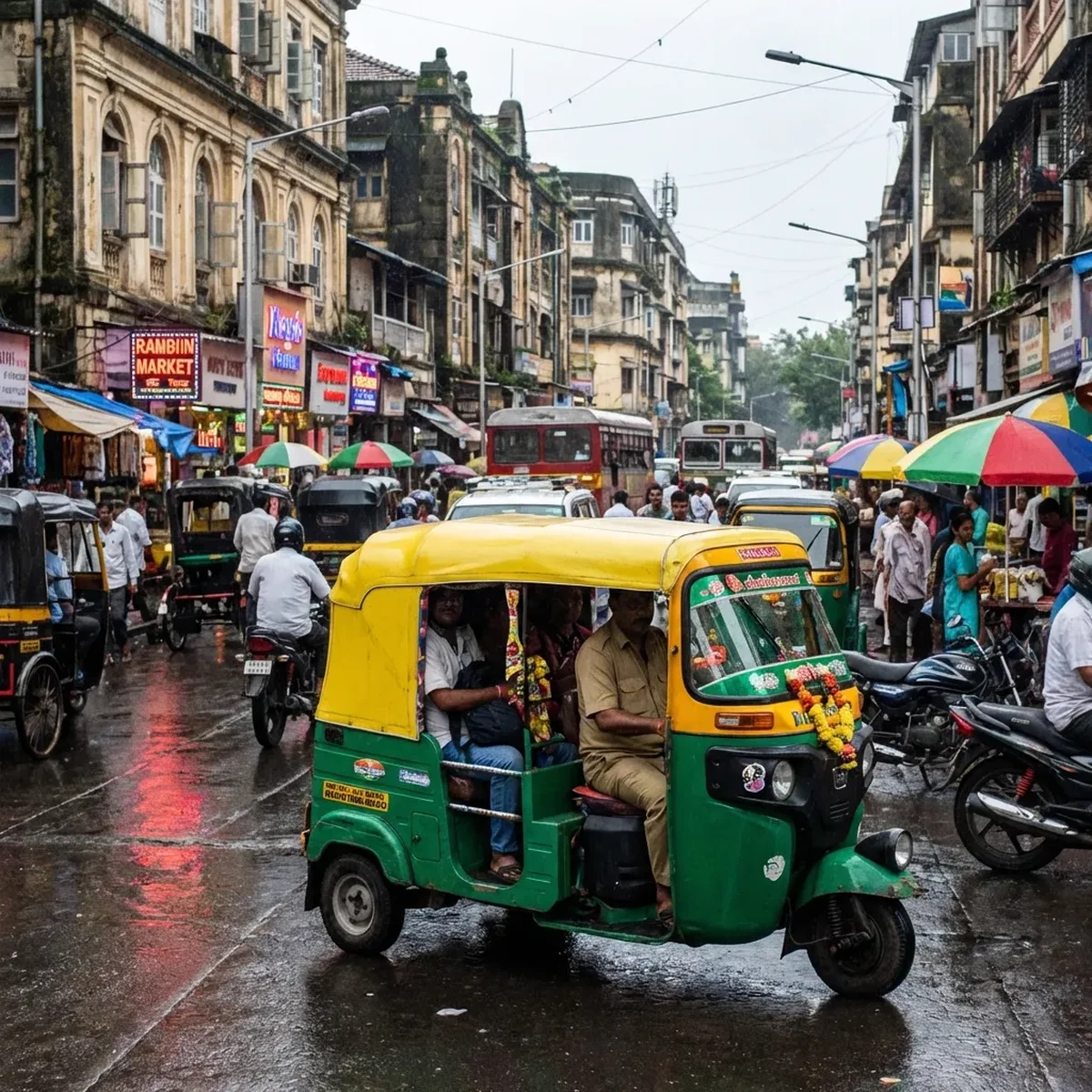
An auto rickshaw — a symbol of everyday Indian transport costs
Chapter 3: The US/Canada IT Migration
Back to Priya's story. Her San Francisco experience is increasingly common among Indian IT professionals who move to the US or Canada.
On paper, the numbers look incredible. A senior developer in Bangalore earns ₹25-40 LPA. The same person in Silicon Valley earns $150-200K (₹1.25-1.65 crore). Five times more! Rich, right?
Then reality hits:
- Rent: A 2BHK in San Francisco costs $3,500/month (₹2.9 lakh). In Bangalore, similar flat: ₹25,000.
- Health insurance: $500-800/month even with employer coverage. In India: ₹1,000/month for family floater.
- Groceries: A bag of basmati rice costs $25 (₹2,100). In India: ₹800.
- Childcare: $2,500-3,500/month per child. In India: ₹5,000-15,000/month for excellent daycare.
- Domestic help: Practically non-existent unless you're earning $300K+. In India: ₹5,000-10,000/month.
After taxes (30-37% federal + state), housing, healthcare, and basic living, Priya's take-home purchasing power was only about 1.5-2x what she'd have in Bangalore — nowhere near the 5x the raw salary suggested.
She eventually negotiated remote work, moved back to Bangalore, kept 50% of her US salary, and is now saving more than she ever did in California. "Reverse migration is the real play," she says.
Honestly, this reverse migration trend surprised me when I first started hearing about it around 2022-2023. I know at least 6-7 people who've done this — worked in the US for 3-5 years, built savings in dollars, and then moved back to India on a remote contract. One of them, a product manager who came back to Pune, told me his math was simple: he was saving $2,000/month in San Francisco after all expenses. Back in Pune on a $90K remote contract, he saves roughly $4,500/month — more than double — because his rent dropped from $3,200 to ₹25,000, his food costs fell by 70%, and he doesn't need a car. Hard to say if this works for everyone, because not all US employers allow remote from India, and there are tax complications with cross-border work. But for those who can swing it, the arbitrage seems like one of the best financial moves an Indian professional can make right now.
Chapter 4: Southeast Asia — Where Indian Money Feels Like Magic
My friend Vikram quit his job in 2022 and spent 8 months as a digital nomad in Thailand, Vietnam, and Bali. He was earning ₹80,000/month freelancing — well below Indian IT average — and living like a king.
"In Chiang Mai, Thailand, my total monthly cost was ₹35,000. Modern studio apartment: ₹12,000. Incredible food — pad thai, green curry, mango sticky rice — ₹100-150 per meal. Professional Thai massage: ₹800 for an hour. Co-working space: ₹5,000/month. I was saving ₹45,000/month while traveling full-time."
Vietnam was even cheaper. "In Ho Chi Minh City, same quality of life for ₹28,000/month. A bowl of pho that would cost ₹300 in a Bangalore Vietnamese restaurant was ₹60 from a street vendor — and 10x better."
But Vikram noticed the limits. "The moment you want anything global — an iPhone, a laptop, Netflix subscription, international flight home — you're paying world prices. The 'cheap living' only applies to local goods and services."
💡 The Tradable vs Non-Tradable Rule
Economists divide goods into "tradable" (globally priced: electronics, cars, oil) and "non-tradable" (locally priced: rent, haircuts, food at restaurants, domestic help). Living cheaply abroad only works for non-tradable goods. An iPhone costs ₹80,000 whether you're in Mumbai, Bangkok, or Berlin. A haircut varies from ₹100 to ₹5,000 depending on where you sit.
Chapter 5: Japan — The Country Where Prices Didn't Move
Japan fascinated me when I was researching this piece because it's the anti-India. While Indian prices have steadily climbed for decades, Japan experienced something bizarre: near-zero inflation for 30 years.
A bowl of ramen in Tokyo cost roughly ¥500-700 in 1995 and ¥500-800 in 2020. Twenty-five years, basically the same price. Can you imagine anything in India staying the same price for 25 years? Chai has gone from ₹3 to ₹20 in that time.
In some ways, this sounds amazing. Your savings don't lose value. ¥1,000 today buys what ¥1,000 bought years ago. Predictable. Safe.
But the dark side is real. Companies don't grow because consumers don't spend (why buy today if it'll cost the same tomorrow?). Wages stagnate — Japan's real wages barely moved for two decades. Young people can't get raises. Innovation slows because there's no urgency. The economy becomes a zombie — alive but not really living.
When inflation finally returned to Japan in 2022-2023 (around 3-4%), the reaction was extreme. People who'd never experienced price increases panicked over changes that Indians wouldn't even notice. A generation had lost the mental framework for dealing with inflation.
Lesson for India: some inflation (2-4%) is actually healthy. It encourages spending, investing, and economic activity. Zero inflation sounds ideal until you see what it actually does to a country over 20 years. Wages freeze, ambition fades, and an entire generation grows up without the financial urgency that drives innovation and career growth. I think India's 4-6% range, while frustrating to live through, is probably preferable to the Japanese stagnation model. Not that anyone enjoys watching dal prices climb — but the alternative might be worse in ways that are harder to see.
Chapter 6: Turkey, Argentina, Egypt — Countries Living Our 1991 Nightmare
While researching for our hyperinflation tutorial, I discovered that several countries are living through currency nightmares right now — in 2025.
Turkey: Inflation hit 85% in October 2022. The lira lost 80% of its value against the dollar in 5 years. A Turkish professor's salary — once comfortable — now barely covers groceries. Sound familiar? This is India 1991 in slow motion.
Argentina: 211% inflation in 2023. Argentines have mastered the art of "blue dollar" — an unofficial exchange rate that values the peso at half the official rate. People convert pesos to dollars immediately upon receiving salary, because holding pesos for even a week means losing purchasing power.
Egypt: The Egyptian pound was devalued multiple times since 2022, losing over 60% of its value. Middle-class families who were comfortable in 2020 are now struggling. Imported goods — cars, electronics, medicine — became unaffordable overnight.
| Country | 2020 Inflation | 2023 Inflation | Currency vs USD (5yr change) |
|---|---|---|---|
| 🇮🇳 India | 6.2% | 5.7% | -12% (₹74 → ₹83) |
| 🇹🇷 Turkey | 14.6% | 64.8% | -80% |
| 🇦🇷 Argentina | 36.1% | 211.4% | -95% |
| 🇪🇬 Egypt | 5.7% | 33.9% | -65% |
| 🇯🇵 Japan | -0.02% | 3.3% | -30% |
India's 12% rupee depreciation over 5 years starts looking surprisingly stable compared to Turkey's 80% or Argentina's 95%. RBI, for all its critics, has maintained relative currency stability. That's worth appreciating.
Chapter 7: What This Means for Indian Investors
After examining money across all these countries, here are the patterns that matter for us:
1. Geographic Arbitrage Is Real
If you can earn in a strong currency (USD, EUR, GBP) while living in a lower-cost country (India, Thailand, Portugal), you create extraordinary purchasing power. This is why remote work for foreign companies is the biggest financial opportunity for young Indians right now. An Indian developer earning $60K from a US company while living in Pune has the purchasing power equivalent of someone earning ₹2+ crore in India.
2. Diversify Across Currencies
The Turkey, Argentina, and Egypt stories teach a brutal lesson: 100% of your wealth in one currency is dangerous. Indians should consider some international exposure — US-focused mutual funds (available through AMCs like Motilal Oswal, ICICI, Kotak), Sovereign Gold Bonds, or even holding some savings in other currencies. Not most of your money — but some.
3. Local Goods Are Cheap; Global Goods Aren't
India is genuinely affordable for local services — food, healthcare, domestic help, education at government colleges. But for globally-priced goods — cars, electronics, imported items — India is often MORE expensive than developed countries (because of import duties and GST). An iPhone 15 costs ₹80,000 in India vs ₹65,000 equivalent in the US.
4. The Rupee Is More Stable Than You Think
Indians constantly complain about the "weak rupee" — and yes, it depreciates 3-5% against the dollar most years. But compared to Turkey, Argentina, Nigeria, Pakistan, or Egypt, the rupee is surprisingly stable. RBI's forex reserves ($600B+) provide a massive buffer. Don't take this stability for granted — but don't panic about it either.
Not sure most people realize this, but a slowly depreciating currency is actually by design. RBI doesn't want the rupee to strengthen too much because that would hurt exports and make Indian IT services more expensive for foreign clients. The 3-5% annual decline is roughly in line with the inflation differential between India and the US — so in real terms, the rupee is pretty much where it should be. What you want to worry about isn't gradual depreciation, it's sudden shocks — like what happened to the Egyptian pound when it dropped 40% in a single month. India's managed float system, backed by those massive forex reserves, makes that kind of overnight collapse very unlikely. I think that's maybe the most underappreciated aspect of India's economic management — not the growth headlines, but the quiet stability of the currency that makes long-term financial planning actually possible.
The Bottom Line
Money is relative. A salary that sounds impressive in one city is poverty wages in another. The rupee that feels "weak" against the dollar is a fortress compared to the Turkish lira. The India that feels "expensive" is absurdly cheap to someone arriving from London or Tokyo.
Understanding global inflation doesn't just satisfy curiosity — it helps you make smarter decisions. About where to live, what to earn in, where to invest, and how to think about the value of money itself.
Bahar ki duniya dekhne se apne ghar ki zyada samajh aati hai. That's true for people, and it's true for money too.