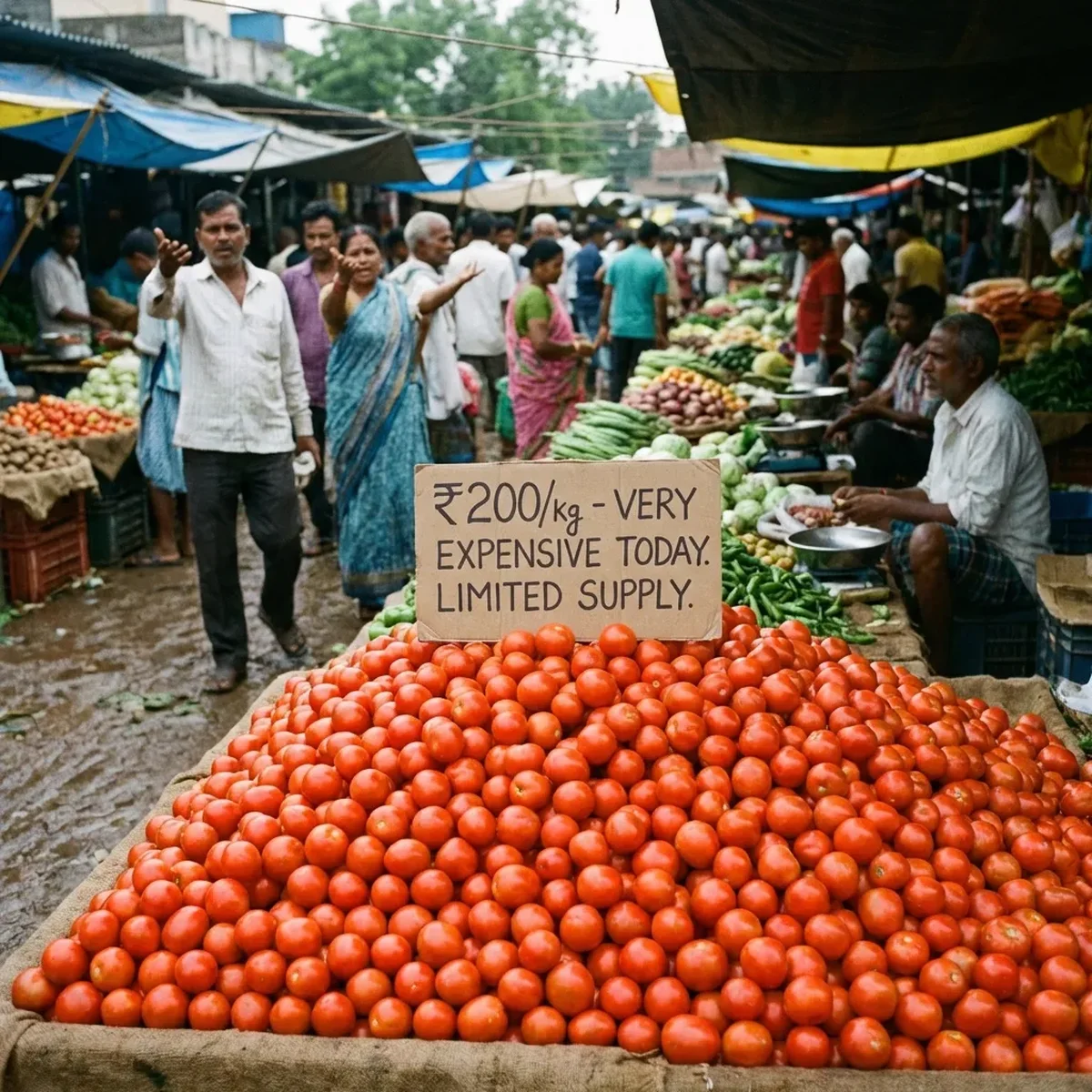
Boss, if there's one vegetable that can make or break governments in India, it's the tomato. Forget GDP and policy debates — when tomato hits ₹200/kg, politicians lose sleep. News channels run 24/7 coverage. Housewives become economics professors.
In July 2023, tomato touched ₹250/kg in some cities. By November 2023, it was back to ₹40/kg. In February 2024, it dropped to ₹20/kg. By monsoon 2024, it spiked again.
Why does this happen? Why can't tomato prices be stable? This tutorial explains the economics behind India's most volatile vegetable.
The Tomato Lifecycle: From Farm to Kitchen
Understanding price volatility requires understanding the supply chain:
| Stage | What Happens | Price Impact |
|---|---|---|
| 1. Farming | Farmer plants tomato; 60-90 days to harvest | Weather, pesticide, labor costs |
| 2. Harvest | Tomatoes are picked and transported to mandi | Fuel cost, wastage begins |
| 3. Mandi/APMC | Commission agents buy from farmers | 8-10% commission added |
| 4. Wholesaler | Buys from mandi, transports to cities | 10-15% margin added |
| 5. Retailer | Sells to consumers | 20-30% margin added |
| 6. Consumer | Buys from local shop/supermarket | Final price: 2-3x farm price |
By the time tomato reaches your kitchen, it's travelled through 3-5 intermediaries. Each takes a cut. Plus wastage — tomatoes are perishable. 20-40% of harvest spoils before reaching consumers.
Why Prices Swing So Wildly
1. Seasonality
Tomato has two main growing seasons in India:
- Rabi (winter): November-March harvest. Cold weather = good production.
- Kharif (monsoon): July-September. Risky — too much rain destroys crops.
Between seasons (April-June, October), supply drops sharply. Same demand + less supply = prices spike.
2. Weather Dependency
Tomatoes are water-sensitive. Too little water: production falls. Too much water: crops rot. Unseasonal rain, floods, or heat waves in growing regions (Maharashtra, Karnataka, Andhra) immediately impact prices nationwide.
3. Short Shelf Life
Tomatoes last 7-10 days max after harvest. Unlike onions or potatoes (which can be stored for months), tomatoes must be sold quickly. When supply exceeds demand, farmers get ₹2-5/kg. When supply falls short, prices shoot to ₹200/kg. There's no buffer.
4. Concentrated Growing Regions
Most of India's tomatoes come from a few districts in Maharashtra (Nashik, Ahmednagar), Karnataka (Kolar), and Andhra Pradesh (Chittoor). If these regions face weather issues, the whole country feels it.
5. No Cold Chain Infrastructure
India lacks proper cold storage for vegetables. In developed countries, tomatoes are stored in controlled environments and released gradually. In India, everything comes to market at once — flooding it when harvest is good, disappearing when it's not.
The 2023 Tomato Crisis: A Case Study
Let's trace what happened in July 2023 when tomatoes touched ₹300/kg:
- March-April: Unseasonal heavy rain damaged standing tomato crops in Karnataka and Andhra Pradesh. Estimated 30% crop loss.
- May: Summer heat wave further reduced production. Farmers who could harvest got good prices (₹50-60/kg).
- June: Early monsoon arrived but was erratic. Some areas flooded, destroying crops. Others remained dry.
- July: Supply crashed. Normal daily arrival at Delhi's Azadpur mandi is 400-500 tonnes. It dropped to 100-150 tonnes. Prices exploded.
- August: Government intervened — allowed tomato imports from Nepal, released buffer stocks, pressured retailers on margins.
- September-October: New harvest arrived. Prices crashed to ₹30/kg. Some farmers couldn't even sell at ₹5/kg — it wasn't worth the transport.
The cycle is brutal for everyone. Consumers pay ₹250/kg in July. Farmers get ₹5/kg in October. Nobody wins consistently.
What Most People Get Wrong About Tomato Prices
From what I've seen, people tend to blame the wrong things when tomato prices spike. Let me walk you through the most common misconceptions, because honestly, understanding what's NOT causing the problem is maybe as important as understanding what is.
Myth #1: "Middlemen are hoarding tomatoes to inflate prices." Look, I'm not saying middlemen are saints. But tomatoes rot in a week. You can't hoard them. Unlike onions (which can be stored for months), there's no physical way to create an artificial shortage through hoarding. The "middleman mafia" narrative's convenient but probably wrong. The real problem's infrastructure, not intent.
Myth #2: "Farmers are getting rich during price spikes." I've talked to farmers in Nashik during the 2023 crisis. When retail price hit ₹250/kg, they were getting ₹80-100/kg at mandi. Sounds good? Not really. Their input costs had already gone up — fertilizer prices doubled, labor wages increased, diesel for pumps became expensive. Net margins were better than usual but not windfall profits. And three months later, they were selling at ₹3/kg and losing money on every crate.
Myth #3: "Imports will solve the problem." During the 2023 crisis, the government allowed tomato imports from Nepal. Helped a bit, but not much. India consumes maybe 10-15 million tonnes of tomatoes annually. You can't import that volume quickly. Plus import quality's often lower (longer transit = older tomatoes), and the logistics are expensive. Imports are a band-aid, not a solution.
Myth #4: "If people just ate seasonal vegetables, prices would be stable." Tomatoes ARE seasonal, but they're also a staple. Indian cooking relies on tomato-based gravies for hundreds of dishes. You can't just substitute bhindi for tomato in dal makhani. The "eat seasonal" advice works for leafy greens, but tomatoes are in a different category — they're foundational to too many recipes.
The real issue's harder to fix and harder to blame on anyone — it's decades of underinvestment in post-harvest infrastructure combined with climate unpredictability. Not sure if that makes good TV news, which is probably why you never hear it.
Tomato vs. Other Vegetables: The Volatility Scale
| Vegetable | Annual Price Range | Why |
|---|---|---|
| Tomato | ₹15-250/kg | Perishable, seasonal, concentrated regions |
| Onion | ₹20-150/kg | Can be stored 3-4 months, so less volatile |
| Potato | ₹15-60/kg | Excellent storage life (6+ months), stable |
| Capsicum | ₹30-200/kg | Similar to tomato seasonality |
| Carrot | ₹30-100/kg | Moderate storage, less volatile |
Tomato's perishability combined with concentrated production creates the perfect storm for price swings. Potatoes, by contrast, can be stored and released throughout the year, maintaining stable prices.
What Can Be Done? (The Policy View)
Experts have suggested various interventions:
- Cold storage infrastructure: Government subsidies for vegetable cold chains. If tomatoes could be stored for even 2-3 weeks, price spikes would reduce.
- Processing industry: Converting tomatoes to paste, ketchup, dried tomatoes during glut seasons. India wastes 30% of vegetables due to lack of processing.
- Buffer stocks: Like we maintain wheat/rice stocks, maintaining tomato paste/puree buffers for crisis times.
- Direct farmer-to-consumer: Reducing intermediaries through farmer markets, FPOs, and e-commerce. Apps like Ninjacart, DeHaat are trying this.
- Price stabilization fund: Government buying tomatoes when cheap, selling when expensive — to smooth volatility.
What Can Consumers Do?
Since policy moves slowly, here's how to handle tomato inflation in your kitchen:
1. Stock Up on Alternatives
Keep tomato puree (Tetra Pak) and canned tomatoes in your pantry. When fresh tomatoes hit ₹150+, use these instead. ₹40 pack of puree equals 1 kg of tomatoes.
2. Substitute in Cooking
Many recipes can use alternatives:
- Tamarind water for sourness
- Kokum or amchur (dry mango powder)
- Curd-based gravies instead of tomato-based
- Kashmiri chili + curd combo for color and tang
3. Batch Buy During Gluts
When tomatoes are ₹20-30/kg, buy extra. Make puree, freeze in ice trays. Home-made tomato paste lasts 3-4 months frozen.
4. Adjust Expectations
During price spikes, just use fewer tomatoes. Your dal doesn't need 4 tomatoes. 2 will work. Ration instead of panic.
Historical Tomato Prices: A Decade of Roller Coasters
If you think 2023 was bad, let's look at the full decade of tomato price volatility. This pattern has been repeating with increasing intensity:
| Year | Peak Price (₹/kg) | Low Price (₹/kg) | Trigger |
|---|---|---|---|
| 2015 | ₹80 | ₹8 | Irregular monsoon in Karnataka |
| 2017 | ₹120 | ₹5 | Glut followed by viral crop disease |
| 2019 | ₹80 | ₹10 | Cyclone Fani damaged Andhra crops |
| 2021 | ₹60 | ₹12 | COVID lockdown disrupted supply chains |
| 2023 | ₹250 | ₹15 | Unseasonal rain + heat wave combo |
| 2024 | ₹120 | ₹20 | Delayed monsoon in Maharashtra |
Look at the ratio: peak-to-low ranges from 6x to 17x within the SAME year. No other commodity in India's basket shows this kind of intra-year volatility. Not onion, not potato, not even petrol. Tomato is genuinely India's most unpredictable price.

The neighborhood sabziwala — caught between wholesale price swings and consumer expectations of stability
The Regional Price Gap (That Nobody Talks About)
Here's something interesting — tomato prices vary wildly across India during the same week. In July 2023, when Delhi was paying ₹250/kg, Bangalore was at ₹120/kg, and Nashik (the growing region) was at ₹60/kg. Why?
Transport costs and distance from growing regions create massive price differentials. Delhi's roughly 1,400 km from Nashik. That's maybe ₹20-30/kg in transport alone (diesel, truck rental, tolls, wastage during transit). Bangalore's closer to Karnataka growing regions, so transport's cheaper. In Nashik itself, you're buying almost direct from farms.
From what I've seen living in different cities, this gap's always been there, but it widens during crises. Normal times, Delhi pays maybe ₹10-15/kg more than Nashik. Crisis times, it's ₹50-100/kg more. The farther you are from growing regions, the worse your tomato inflation gets.
The odd part's that India doesn't have a unified agricultural market even now. Prices in Azadpur mandi (Delhi) and Vashi mandi (Mumbai) can differ by 30-40% on the same day for the same vegetable. There's no price arbitrage mechanism that efficiently moves supply from low-price to high-price regions. The mandi system's state-controlled, fragmented, and honestly outdated. Some progress's been made with e-NAM (electronic National Agriculture Market), but adoption's been slow.
Impact on Your Monthly Kitchen Budget
A typical Indian kitchen uses 4-6 kg of tomatoes per month for a family of four. Here's what that means for your grocery bill at different price points:
| Tomato Price | Monthly Cost (5 kg) | Annual Cost | % of ₹15,000 Grocery Budget |
|---|---|---|---|
| ₹25/kg (glut) | ₹125 | ₹1,500 | 0.8% |
| ₹60/kg (normal) | ₹300 | ₹3,600 | 2% |
| ₹150/kg (crisis) | ₹750 | ₹9,000 | 5% |
| ₹250/kg (2023 peak) | ₹1,250 | ₹15,000 | 8.3% |
At ₹250/kg, your monthly tomato bill alone is ₹1,250 — more than what many families spend on Dal (₹800-1,000/month). It sounds absurd, but during the 2023 crisis, families in Delhi were genuinely rationing tomatoes like a scarce luxury item. Restaurants added "tomato surcharge" to their menus. Memes flooded Twitter comparing tomato prices to property rates.
Why Government Interventions Don't Really Work
Every time tomato prices spike, the government announces measures. "We're releasing buffer stocks! We're allowing imports! We're capping retailer margins!" And honestly, these help a tiny bit, but they're treating symptoms instead of the disease.
Buffer stocks sound good in theory. But tomatoes can't be stored like wheat. You can maintain tomato paste or puree stocks, which the government tried in 2023. But processed tomatoes don't fully substitute for fresh ones — you can't make a salad or tomato slice for a burger with tomato paste. The texture and use cases are different.
Capping retailer margins seems logical — "don't let them profiteer!" But here's what actually happens. When you cap margins at, say, 10%, retailers just stop stocking tomatoes. Why risk inventory spoilage and handling costs for a tiny controlled margin? So supply at retail level drops further, making the shortage worse. I've seen this happen in my neighborhood — during the 2023 crisis, several small vegetable shops just stopped keeping tomatoes for two weeks. Too much hassle for too little profit.
The real solutions — cold chains, processing plants, better roads, weather-resistant farming techniques — take years and billions of investment. Politicians need quick wins before the next election cycle. So we get band-aids, not surgeries. Not sure if that'll change anytime soon, but maybe I'm too cynical.
The Climate Change Factor (That's Getting Worse)
I hate to sound alarmist, but from what I've seen in the data, tomato volatility's been increasing. The 2015 spike was ₹80/kg. The 2023 spike was ₹250/kg. That's not just inflation — that's structural destabilization.
Climate change is making weather more unpredictable. Monsoons are arriving late or early. Unseasonal rains are more frequent. Heat waves are more intense. Tomatoes, being sensitive crops, get hammered by all of this. And it's not like farmers can just switch to drought-resistant varieties overnight — that takes years of research, testing, and adoption.
The scary part's that tomatoes aren't unique. Other vegetables — capsicum, beans, leafy greens — are showing similar volatility patterns. We might be entering an era where "stable food prices" becomes a thing of the past. Maybe future generations will just accept that vegetables cost ₹50/kg one month and ₹200/kg three months later. Honestly, hard to say, but the trend's not encouraging.
The Bigger Picture: Food Inflation in India
Tomato is a symptom of a larger issue: India's food supply chain is inefficient. We produce enormous quantities of vegetables but waste 30-40% of it. The difference between farm price and consumer price is too high. Weather dependency makes everything unstable.
Food inflation in India's CPI basket carries a weight of nearly 46% — meaning almost half of what the "inflation number" captures is food prices. When RBI says "CPI is 5.5%," a huge chunk of that is driven by vegetables, cooking oil, and cereals. Your real kitchen inflation is often 8-12%, not the headline 5-6%.
As climate change intensifies, expect more volatility. Unseasonal rains, heat waves, and floods will become more common. The tomato roller coaster will continue — and probably get wilder.
Understanding why prices move the way they do won't make your grocery bill smaller. But at least you'll know it's not "hoarders" or "middlemen mafia" (the usual scapegoats) — it's basic supply and demand, complicated by infrastructure gaps and weather roulette.
The solution? Better cold chains, more processing capacity, reduced intermediaries, and ultimately — accepting that in a country where 140 crore people need vegetables daily, even a 5% supply disruption creates massive price shocks. Until India's food infrastructure catches up with its food demand, the tomato roller coaster will keep running.
There are some positive developments. The government's Operation Greens (now subsumed under PM-KISAN Sampada) aims to build food processing infrastructure. Companies like ITC, Reliance Fresh, and Jio Mart are investing in farm-to-fork supply chains. Startups like Ninjacart and DeHaat are reducing intermediaries through technology. Cold chain capacity has grown 50% since 2019. But progress is slow compared to the scale of the problem — India needs 3-4x more cold storage capacity than it currently has, and building that takes decades, not years.
For the foreseeable future, your best defense against tomato inflation is a well-stocked pantry (puree, canned tomatoes, dried tomato powder), flexible cooking habits, and the understanding that this is a structural problem with no quick fix.
Use our Inflation Calculator to see how vegetable prices have changed over the years compared to wages. Also check our Price Tracker to monitor real-time cost changes across important commodities.