
Arre boss, there's something you need to understand about chai in India. It's not just a beverage. It's not even just a ritual. It's an economic indicator, a social equalizer, and the fuel that powers this entire country. From auto rickshaw drivers to IT executives, from factory workers to supreme court judges — everyone needs their morning chai.
And if you want to understand how India's economy has changed over the last 30 years, forget GDP figures and budget speeches. Just walk up to your nearest chai wala and look at the price board.
I'm writing this article sitting at Sharma ji's chai stall in my neighborhood in Delhi. He's been serving tea from this exact spot since 1994. Three decades. He's watched governments rise and fall, seen the economy liberalize, survived demonetization, and made it through a pandemic. All while serving the same basic product: chai.
His price journey tells a story more compelling than any economics textbook.
The 50 Paise Generation: When Chai Was Almost Free
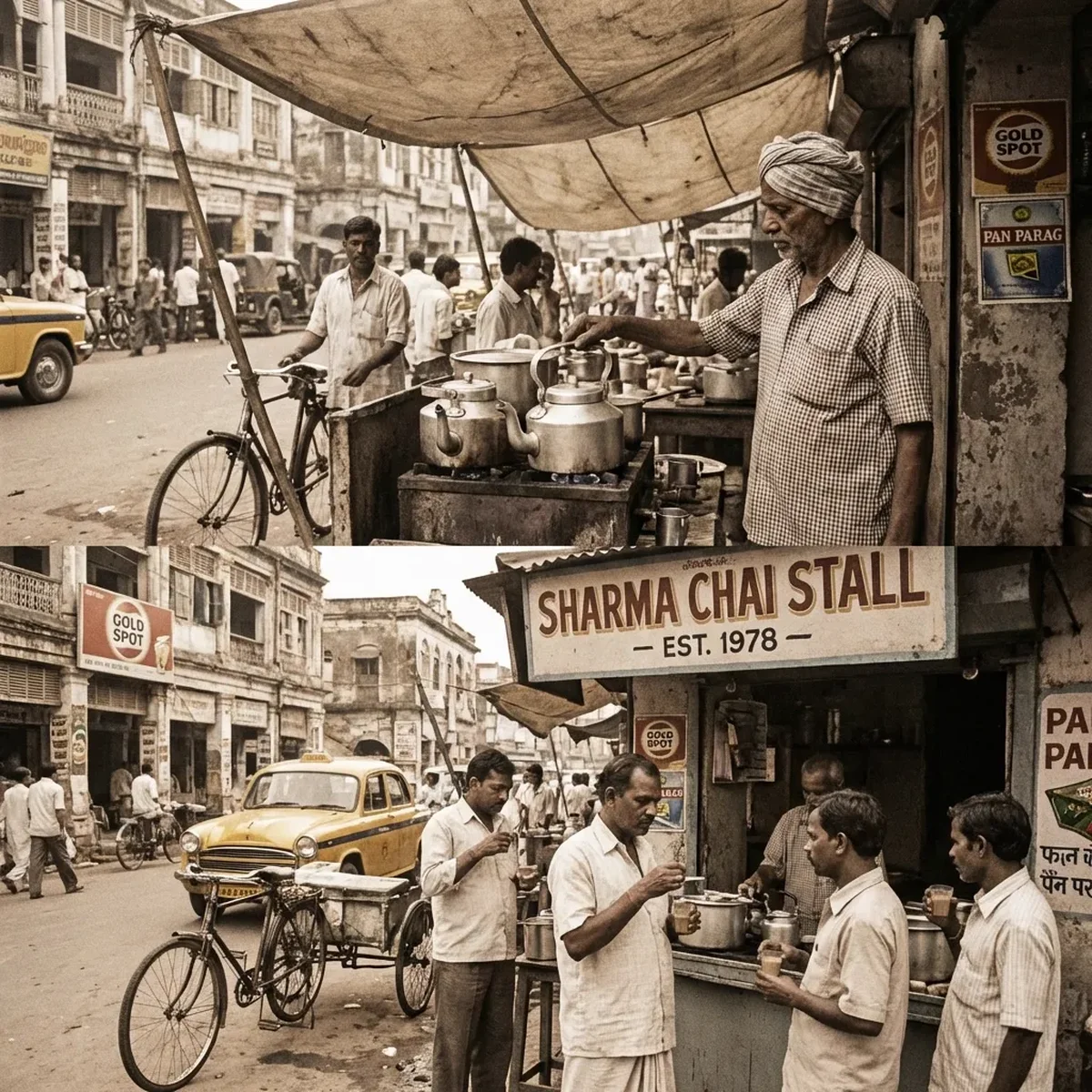
Sharma ji's stall in the early days - simpler times, simpler prices
Sharma ji tells me that when he started in 1994, a cup of chai cost 50 paise. Half a rupee. You'd give him a one-rupee coin, and he'd give you two glasses of chai back. Or, more commonly, you'd drink a chai and leave with a 50 paise return.
"Log apni khushi se ek rupiya de dete the," he reminisces. People would voluntarily give him one rupee and tell him to keep the change. That 50 paise tip felt generous at the time.
Let me put that in perspective. In 1994:
- A government clerk's salary was about ₹2,500-3,000 per month
- Petrol was ₹13 per liter
- A movie ticket was ₹5-10
- A local train ticket in Mumbai was ₹1
- A landline phone call was 50 paise for 3 minutes
In that context, 50 paise for chai made sense. It was the smallest meaningful purchase you could make. The minimum unit of economic activity.
The Anatomy of a ₹15 Cup of Chai

The ingredients that make magic - every one of them has gotten expensive
Today, Sharma ji charges ₹15 for a regular chai. That's a 30x increase in 30 years. But is he making 30x the profit? Let's break down his costs.
| Ingredient | 1994 Cost | 2025 Cost | Increase |
|---|---|---|---|
| Tea leaves (per kg) | ₹40 | ₹350 | 8.75x |
| Milk (per liter) | ₹6 | ₹60 | 10x |
| Sugar (per kg) | ₹8 | ₹45 | 5.6x |
| Cardamom (per 100g) | ₹50 | ₹400 | 8x |
| Ginger (per kg) | ₹15 | ₹120 | 8x |
| LPG Cylinder | ₹125 | ₹1,800 | 14.4x |
The biggest shock in that table? LPG cylinder. A 14x increase. This is the silent killer for all street food vendors. Nobody talks about it, but fuel costs have devastated the small food business economy.
The Cost Per Cup Calculation
Sharma ji makes approximately 200 cups of chai per day. His daily costs work out to:
- Tea leaves: ₹70 (200g at ₹350/kg)
- Milk: ₹300 (5 liters at ₹60/liter)
- Sugar: ₹45 (1 kg)
- Spices: ₹50
- LPG (prorated): ₹60
- Glasses/cups/water: ₹50
- Rent (his stall spot): ₹300/day
Total daily cost: ₹875. Revenue at ₹15 x 200 cups = ₹3,000. Daily profit: ₹2,125.
Monthly profit: roughly ₹63,000. Sounds decent, right? But this is for 12-14 hours of work, 7 days a week, no holidays, no sick leave. And ₹63,000 in Delhi isn't what it used to be.
I think what surprised me about this breakdown is how thin the margins are. Milk alone is 35% of his costs, and milk prices have climbed 8-10% per year for the last decade. If Sharma ji absorbs a milk price hike instead of raising chai prices, his daily profit drops from ₹2,125 to maybe ₹1,800. Over a month, that's ₹10,000 less — a real hit for someone with no savings cushion. But if he raises prices by even ₹2 per cup, he probably loses 20-30 customers. He's stuck between input inflation and customer sensitivity. Neither option is great, honestly.
There's also a hidden cost that doesn't show up in anyone's books: municipal bribes. In most cities, street chai vendors pay ₹100-300 per week to inspectors or police to keep operating. That's maybe ₹1,000-4,500 per month going straight to corruption — 2-7% of revenue that can't be deducted or avoided. Nobody discusses this when talking about food prices, but it's a real cost that gets passed to you and me. Maybe the ₹15 chai should be ₹13 if the system were cleaner.
Seasonal variation is another thing most people miss. In Delhi's summer, Sharma ji's sales drop 40-50%. People switch to lassi and nimbu pani. But his costs — rent, LPG — don't change. He survives summer by running a small tab with suppliers, paying it back during winter. Zero documentation, pure trust. From what I can tell, this is how 80% of India's street food economy actually works.

The art of the perfect chai - timing, temperature, and love
Why Cutting Chai is Economic Genius
If you've ever been to Mumbai, you know about "cutting chai." Half a cup of chai. It's not for people who want less chai — it's for people who want the same satisfaction at a lower price point.
Here's the business intelligence behind it:
A full chai costs ₹15. A cutting costs ₹8-10. But here's the thing — the vendor's cost per cup is the same for a full or cutting. The tea-to-milk ratio doesn't change. Only the quantity does. So a ₹10 cutting might have a 50% margin while a ₹15 full has a 65% margin.
BUT — the cutting attracts customers who would otherwise not buy anything. A chai-wallah with cutting options might sell 300 cups a day instead of 200. The higher volume makes up for the lower margin.
This is price discrimination in its purest form. MBA graduates learn about this in case studies. Mumbai's chai wallahs figured it out through survival instinct.
The Survival Story: Inflation, Competition, and Adaptation

The cutting - Mumbai's answer to affordable indulgence
Sharma ji has survived 30 years through constant adaptation. Let me tell you some of the challenges he's faced and how he's overcome them.
Challenge 1: Café Culture
In the 2000s, Café Coffee Day and Barista appeared. Suddenly, there was "branded" coffee and chai. Would young people abandon street chai for air-conditioned cafés?
Sharma ji's response: He added "special chai" with extra ginger during winters. He created a "kadak chai" variant. He started serving in kulhads (clay cups) for customers who wanted an authentic experience.
Result: He kept his regular customers and attracted tourists who wanted "real Indian chai."
Challenge 2: The 2016 Demonetization
Overnight, cash disappeared. His customers — mostly daily wage workers and office staff — simply didn't have ₹10 or ₹20 notes.
Sharma ji's response: He ran on credit for two weeks. "Jo log roz aate the, unka tab likh leta tha." He kept a small diary of who owed what. When cash came back, everyone paid up.
Result: He built deeper loyalty. Customers who he'd trusted during the crisis became lifelong regulars.
Challenge 3: Digital Payments
When Paytm and PhonePe became common, younger customers started asking for UPI. Sharma ji, at 60+, had never used a smartphone properly.
Sharma ji's response: His grandson set up a Paytm account. Now there's a QR code laminated and stuck to his pot.
Result: He gets more customers, especially "IT types" who never carry cash.
The Café vs Street Chai: A Price Comparison
Let me give you some perspective on what chai costs in different contexts in India today:
| Location | Price | Ambience |
|---|---|---|
| Street Chai (Sharma ji) | ₹15 | Standing, roadside, authentic |
| Chaayos | ₹120-180 | Casual café, AC, customizable |
| Starbucks Chai Latte | ₹300-400 | Premium café, WiFi, status symbol |
| 5-Star Hotel | ₹500-800 | Luxury, service included |
The same basic product — tea leaves, milk, sugar, spices — costs anywhere from ₹15 to ₹800 depending on where you consume it. That 50x difference is pure "ambience premium."
And here's the crazy thing: many people happily pay ₹300 for a Starbucks chai latte but will bargain with Sharma ji about whether ₹15 is "too much." The brand, the aircon, the WiFi — that's what costs ₹285. The actual chai is the same.
I think what most people get wrong about chai pricing is that they treat it as a simple commodity — "it's just tea, how much should it cost?" But there are probably three or four layers of value being delivered that nobody thinks about. There's the product itself (the chai). There's the service (instant preparation, no waiting, no reservation). There's the location (right outside your metro station or office). And there's the social experience (the conversation, the standing around, the morning ritual). When you pay ₹15 for Sharma ji's chai, you're getting all four. When you pay ₹300 at Starbucks, you're getting maybe two of those four, plus aircon and a chair. Honestly, I'm not sure which is the better deal. From what I've seen, the street chai vendor is probably the most underpriced service provider in India, and it's only because customers perceive it as a "low-value" transaction that the price stays so low. If Sharma ji charged ₹25 — still one-twelfth of a Starbucks — he'd earn ₹1.5 lakh/month. That seems more fair for 14-hour days and 30 years of skill, but he knows his customers would disappear.
What Chai Teaches Us About Inflation
After three decades of chai economics, here are the lessons:
Lesson 1: Fuel Drives Everything
The biggest input cost increase has been LPG. And LPG prices are linked to global crude oil prices. So when you see petrol at ₹100+, remember — it's not just affecting your car. It's affecting every hot meal, every chai, every paratha you eat.
Lesson 2: Labor Doesn't Keep Up
Sharma ji's effective hourly wage, after 30 years of experience, works out to about ₹200/hour. That's better than minimum wage, but not by much. Meanwhile, his ingredients have increased 8-14x. He's running to stay in place.
Here's something that probably hit me harder than it should have. I did a rough calculation of Sharma ji's lifetime earnings. Thirty years, roughly ₹40,000-63,000/month depending on the era, working every single day. His total career earnings are maybe ₹1.5-1.8 crore. That sounds like a lot until you realize a mid-level software engineer in Bangalore earns that in 8-10 years while working 5 days a week with paid vacations, health insurance, and a retirement fund. Not sure what the "right" amount is for someone who's fed an entire neighborhood for three decades, but it seems like the market dramatically undervalues this kind of work. Maybe that's just how economies work — scalable work pays more than non-scalable work — but watching Sharma ji stand in Delhi's 45-degree heat making his 200th chai of the day while I sit in an air-conditioned room writing about it... I don't know, it makes you think.
Lesson 3: Trust is a Currency
During demonetization, Sharma ji's willingness to give credit saved his business. Relationships beat transactions. In an age of apps and algorithms, human connection still matters.
Lesson 4: Adaptation is Survival
UPI QR codes, kulhad chai for tourists, special winter variants — the vendors who adapt survive. Those who say "hum toh aise hi karenge" get left behind.

The office chai break - where deals are made and stress is relieved
The Cultural Significance of Affordable Chai
There's something deeply democratic about a ₹15 chai. A CEO and a security guard can stand at the same stall, drink from the same pot, and have a conversation as equals. That's rare in a country as stratified as India.
When I was starting my career, I'd go to Sharma ji's stall every morning. Not just for chai, but for the community. Auto drivers discussing politics. Office workers complaining about their bosses. College students preparing for exams. All standing in a rough circle, sipping chai, being human.
This social function is worth protecting. If street chai becomes ₹50 or ₹100, that democratic space collapses. Only certain people will be able to afford the daily ritual. Something intangible but important will be lost.
I've noticed this already starting to happen with the branded chai chains. Walk into a Chaayos or a Tea Trails — it's mostly young professionals and college students. You won't see the auto driver or the electrician or the newspaper vendor there. Not because they're not welcome, but because ₹150 for a chai creates an invisible price barrier that filters out a large chunk of India's working population. That's the trade-off of "premiumizing" something as basic as chai. You get consistency, cleanliness, and Instagram-worthy cups. But you lose the social mixing that happens naturally at a ₹15 stall. Hard to say which is "better" — it depends on what you value. But I think there's something worth preserving about a ₹15 price point where anyone, regardless of income, can participate in the same daily ritual.
The Future of Street Chai
What happens next? Based on current trends:
- Short term: Prices will hit ₹20-25 in metro cities. The ₹10 cutting will become ₹15.
- Medium term: Some vendors will "brand" themselves. You'll see proper signage, consistent recipes, maybe even apps for pre-ordering.
- Long term: A two-tier market. "Premium street chai" at ₹50-80 for tourists and younger customers. Basic chai at ₹25-30 for regulars.
The vendors who survive will be those who understand their unique value: authenticity, speed, accessibility, and community. No café can replicate standing on a busy road, sipping hot chai from a glass, watching the city wake up.
My Morning Ritual
I still start every day with chai from Sharma ji's stall. ₹15 for about 5 minutes of peace before the world demands my attention. It's the best investment in my mental health.
When I was in college, chai was ₹3. Now it's ₹15. By the time I retire, it might be ₹50. I'll still be standing there, complaining about prices like my father did, while secretly grateful that the ritual continues.
Because chai isn't just about caffeine or warmth. It's about connection — to a place, to a community, to a tradition that stretches back generations. That's worth paying for, even as the price keeps climbing.
Use our Inflation Calculator to see how much ₹1 of chai from your childhood is worth today.