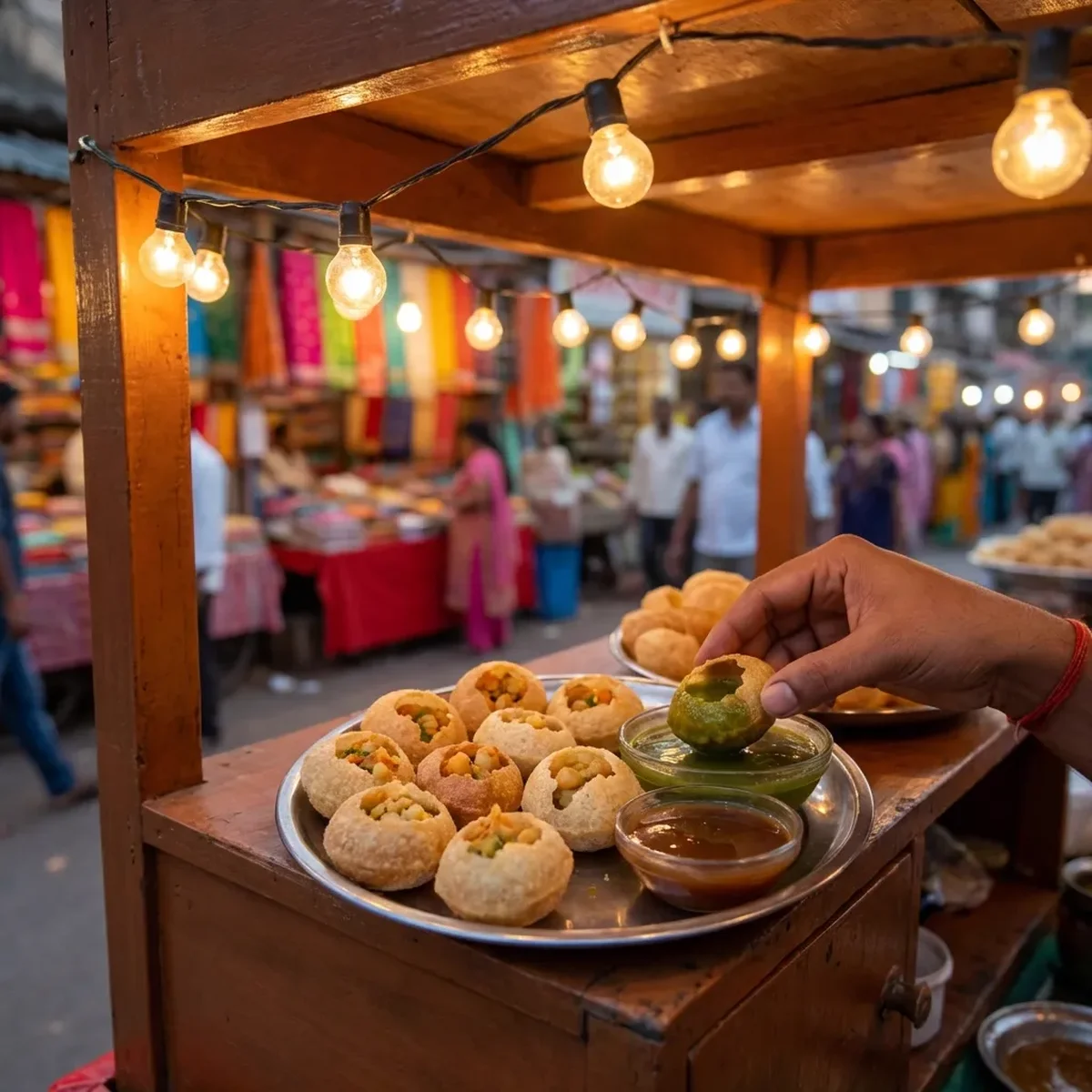
Okay so this is something I've been thinking about for a while now. You know how economists love their Big Mac Index to track purchasing power across different countries? Well, in India, we've got something way better: watching what happens to the price of pani puri. I'm serious. That little plate of crispy shells filled with spiced potato and tangy water? It's probably the most honest inflation tracker you'll find. No corporate pricing games, no brand markups, just raw economics playing out on a street cart. Wheat, potatoes, onions, spices, fuel, labor—it's all there, and when costs go up, vendors can't absorb it. They pass it on immediately or they don't eat that night.

Back When a Plate Cost Just 2 Rupees
Early 2000s, you could get a plate of pani puri—6 pieces—for ₹2 pretty much anywhere in India. Didn't matter if you were pulling a rickshaw or wearing a suit, everyone paid the same. Vendors weren't hurting either because potatoes ran about ₹4/kg and LPG had those government subsidies propping it up. Life was simpler, or maybe I'm just getting nostalgic.
Looking at what ₹2 actually meant back then makes the change even more stark. India's per capita income in 2000 was somewhere around ₹16,000 per year. Daily wage workers pulled in maybe ₹50-80, so a plate of pani puri was less than 3% of their day's earnings. Fast forward to today—same worker earns ₹300-500 daily, but pani puri runs ₹40-50. That's 8-10% of what they make. So yeah, this snack's gotten expensive way faster than wages have gone up, especially if you're on the lower end of that income scale.
Back then, the whole supply chain worked differently too. Vendors bought from local mandis where prices stayed pretty stable—potatoes between ₹3-5 per kg throughout most of the 1990s. Onions usually kept under ₹10 per kg unless some weather disaster hit. Wheat flour for the puris ran ₹8-10 per kg. Do the math: a vendor prepping 100 plates spent roughly ₹40-50 on ingredients, sold everything for ₹200, and pocketed ₹150+ after fuel and water. Decent margins, I think.
Regional Price Variations: Mumbai vs Delhi vs Kolkata vs Bangalore
One thing that's really interesting about tracking pani puri prices is how much they vary by region. Unlike branded products with fixed MRPs, street food prices depend entirely on local economics—rent, competition, ingredient costs, and how much money the people nearby actually have to spend.
Mumbai: The Most Expensive Plate
Mumbai's where you'll pay the most. A standard plate of 6 pieces runs ₹40-60 in areas like Juhu, Bandra, and Lower Parel. Near railway stations in suburbs like Andheri or Borivali, you might find it for ₹30-40. Real estate drives everything here. Even a pavement vendor deals with "hafta" (protection payments) of ₹500-1,000 weekly to local authorities or strongmen. Vendor near Marine Drive told me his monthly fixed costs—hafta, water, cart storage—hit ₹8,000 before he's sold a single plate.
Delhi NCR: The Golgappa Capital
Delhi loves its golgappas, and competition's intense. Prices run ₹20-30 in Old Delhi and Chandni Chowk, ₹40-50 in Khan Market or Connaught Place. Interesting thing about Delhi is this "unlimited golgappa" model some vendors use. Pay ₹30-40, stand at the stall, eat as many as you can handle. Popular with customers but squeezes vendor margins down to almost nothing. Vendor in Lajpat Nagar told me the average customer downs 10-12 pieces in an "unlimited" session—basically cuts his per-piece revenue in half compared to fixed plates.
Kolkata: Puchka Economics
Kolkata's beloved "puchka" stays among the cheapest in any metro. A plate of 6-8 pieces runs ₹15-25, with some vendors in Gariahat and College Street still doing ₹10-15. Lower cost of living, cheaper real estate, and a culture that values affordable street food all help keep prices down. Even so, Kolkata's seen a 5x jump from the ₹3 plates of the early 2000s.
Bangalore: The Tech City Premium
Bangalore's a unique case. In tech-heavy areas like Koramangala, Indiranagar, and Whitefield—where IT workers have more disposable income—pani puri's hit ₹50-60 per plate. Some "gourmet" stalls near tech parks charge ₹80-100 for fancy flavored versions. Meanwhile, older neighborhoods like Basavanagudi or Jayanagar keep prices at ₹25-35. That's almost a 100% gap within the same city, showing how local purchasing power matters way more than ingredient costs at this point.
Small Towns: The Last Bastion of Affordability
Tier-2 and tier-3 cities like Lucknow, Patna, Indore, Bhopal, and Varanasi keep pani puri relatively affordable at ₹10-20 per plate. Indore, famous for street food, offers some of the best value—generous portions at ₹15-20. Lower rents, cheaper labor, proximity to farms—all help. But the gap's closing fast. Between 2020 and 2025, small-town prices jumped 40-60%, actually outpacing metros in percentage terms since fuel and commodity costs have evened out across India.

What the Numbers Actually Tell Us
Street food inflation's probably a better gauge of what's really happening in the economy than official CPI numbers. Why? There's no corporate cushion here. A street vendor can't absorb rising costs—when his ingredient bill goes up, he's got to raise prices or he doesn't make rent that month. Simple as that.
| Year | Price / Plate (6 pcs) | Implied Value |
|---|---|---|
| 2000 | ₹2 | Baseline |
| 2010 | ₹10 | 5x Increase |
| 2015 | ₹20 | 10x Increase |
| 2020 | ₹30 | 15x Increase |
| 2024 | ₹40 - ₹50 | 20x - 25x Increase |
Look at those numbers—20x increase over 24 years. That's brutal for anyone earning daily wages. Your purchasing power just gets obliterated at that rate.
The Economics of Running a Pani Puri Stall: A Daily Cost Breakdown
If you want to understand why prices have shot up so fast, you've got to look at what vendors actually deal with. Most pani puri sellers run as micro-entrepreneurs with zero formal business training, but honestly, their cost management would probably impress plenty of MBA grads. Here's what a typical vendor's daily costs look like in a mid-sized Indian city in 2025, from what I've seen:
Ingredient Costs (Per Day, ~150 Plates)
- Semolina/Atta for puris: 2 kg at ₹40-50/kg = ₹80-100. Puris are probably the most labor-intensive part, and you're looking at pre-dawn preparation if you make them yourself. A lot of vendors don't bother anymore—they just buy pre-made puris from wholesale suppliers at ₹3-4 per piece, which adds up to maybe ₹450-600 for 150 plates.
- Potatoes: 3-4 kg at ₹30-40/kg = ₹90-160. Potato prices swing wildly in India—everyone knows this. During that 2024 potato crisis, prices hit ₹50-60/kg in several states, and vendors had no choice but to cut back on filling size.
- Onions: 1 kg at ₹30-80/kg = ₹30-80. Onion price swings are practically legendary at this point. One bad monsoon and prices can triple overnight—I'm not exaggerating.
- Chickpeas (chana) and moong: 1 kg at ₹80-120/kg = ₹80-120. These protein-rich additions have been climbing steadily—maybe 8-10% every year.
- Spices (chaat masala, cumin, chili, tamarind, mint): ₹50-80 per day. Spice prices have jumped—I'd say 60-80% between 2020 and 2025—mostly because climate change is messing with crops in Rajasthan and Madhya Pradesh.
- Water (for pani): ₹20-50. In cities where you can't trust tap water, vendors buy 20-liter cans at ₹20-30 each, using maybe 1-2 per day.
Non-Ingredient Costs
- Commercial LPG cylinder: ₹100-150 per day (prorated). A commercial cylinder runs ₹1,800-2,000 and lasts roughly 15-18 days for your typical vendor.
- Cart rental or storage: ₹50-100 per day (₹1,500-3,000/month).
- Hafta/bribes to local authorities: ₹30-70 per day (₹1,000-2,000/month). This one's probably the most painful cost, and nobody talks about it. Vendors pay off police, municipal workers, and local strongmen just to keep their spot.
- Disposable plates, napkins, spoons: ₹50-80 per day. Shifting from those dried-leaf plates (pattal) to paper or plastic has added maybe ₹0.50-1.00 per serving.
- Transportation: ₹30-50 per day to move the cart and supplies from home to selling spot.
Add it all up and you're looking at roughly ₹1,200-1,800 in daily operating costs for a vendor serving 150 plates. At ₹40 per plate, gross revenue hits ₹6,000, so net daily income lands somewhere between ₹4,200-4,800. Sounds decent until you remember most vendors work 10-12 hours a day, seven days a week, with no health insurance, no pension, no paid leave, and they're constantly worried about their cart getting confiscated during those "anti-encroachment" drives.
Shrinkflation: How Street Food Gets Quietly Downgraded
Price hikes aren't the only way inflation shows up in street food. There's this sneakier thing happening—shrinkflation. That's when the price stays put but the product gets smaller, thinner, or just lower quality. It's everywhere in India's street food economy, and pani puri might be the worst example.
Smaller Puris
Most obvious change? Size of the puri itself. Early 2000s, a standard puri was roughly 3-3.5 inches across—nice crunchy shell that held a generous filling. Now, a lot of vendors have shrunk down to 2-2.5 inch puris. Doesn't seem like much, but do the math: 25% diameter reduction translates to maybe 40% less filling capacity. You're eating way less food for the same "plate of 6."
Less Filling Per Puri
Even inside that smaller shell, filling ratios have changed. Vendors used to pack in a full spoonful of mashed potato, chickpeas, and onion. Now many give you a lighter half-spoon. Protein-rich stuff—chickpeas, moong—gets cut first because it's the priciest. Some vendors have quietly swapped chickpeas for boiled peas, which run about 40% cheaper.
Watered-Down Pani
Pani (the flavored water) is where shrinkflation's hardest to catch but hits taste the hardest. Traditional pani uses generous amounts of tamarind, mint, coriander, cumin, black salt. Tamarind prices doubled between 2018 and 2025 (₹80/kg to ₹160/kg), mint's gotten seasonal and pricey, so vendors water it down. What you get is thinner, less flavorful liquid that older customers spot immediately but younger ones think is normal. Some vendors just use artificial chaat masala concentrate now instead of making fresh pani—pretty big quality drop, if you ask me.
Fewer Pieces Per Plate
In plenty of cities, the "standard plate" has quietly gone from 6 pieces to 5. Most common in metros where vendors spin it as "premium quality" with better hygiene. Really, it's a 16% price hike dressed up as an upgrade. In tourist spots like Mumbai's Chowpatty or Delhi's Chandni Chowk, vendors now offer 4 pieces as "small" and 6 as "regular" at a higher price—creating pricing tiers that didn't exist before.
Why The Price Explosion? Key Factors
It's not just plain inflation doing this. Several bigger factors have pushed prices up:
- Commercial LPG Costs: Removing subsidies for commercial cylinders has probably been the biggest hit. Fuel's often 30% of what a vendor spends daily.
- Vegetable Volatility: Onion and potato prices don't stay stable anymore. When onions spike to ₹80/kg, vendors either raise prices or cut back on quantity.
- The "Hygiene" Premium: Modern customers want mineral water and gloves. This whole "gentrification" of street food adds ₹5-10 per plate right away.

Comparing Street Food Inflation: Pani Puri vs Vada Pav vs Samosa vs Chai vs Momos
Pani puri isn't the only street snack getting pricier. All across India's street food scene, prices have jumped way faster than what official CPI data suggests. Here's how different snacks stack up:
| Item | Price in 2000 | Price in 2025 | Increase |
|---|---|---|---|
| Pani Puri (6 pcs) | ₹2 | ₹40-50 | 20-25x |
| Vada Pav (1 pc) | ₹5 | ₹25-40 | 5-8x |
| Samosa (1 pc) | ₹3 | ₹15-25 | 5-8x |
| Chai (1 cup) | ₹2-3 | ₹15-20 | 5-10x |
| Momos (6 pcs) | ₹10 | ₹60-80 | 6-8x |
Pani puri stands out as the worst for inflation in this group, and there's a reason. Vada pav and samosa work with simpler prep and fewer perishables. Samosa filling—potato and peas—is cheap and lasts. Deep-frying oil's pricey but gets reused across batches. Chai benefits from the tea industry's massive scale and milk prices that stay fairly stable thanks to cooperative pricing (Amul). Momos are expensive now but started higher, and their ingredients (maida, cabbage, basic protein) haven't gotten hit as hard.
Pani puri, though? It's built on volatile stuff—potatoes, onions, tamarind, spices, cooking fuel—all vulnerable to weather, policy shifts, supply chain chaos. Basically, it's a commodity basket pretending to be a simple snack.
The Vendor's Perspective: Stories from the Street
Every price hike has a human story behind it. I've talked to several pani puri vendors across different cities to understand how they're dealing with these relentless cost increases.
Ramesh, 52, Lucknow — 28 Years in the Business
"When I started in 1997, I sold a plate for ₹1.50. My father was also a pani puri vendor. He could support a family of five on this income. Today, I sell at ₹20 per plate and I struggle to pay my son's school fees. The biggest change isn't the ingredients—it's the hafta. Every month, different people come asking for money. Municipal, police, local goondas. If I don't pay, my cart disappears the next day. I'd say 15-20% of my income goes to these invisible costs."
Lakshmi, 38, Hyderabad — Running Her Mother's Stall
"My mother set up this stall in 1995. She used to make everything from scratch—the puris, the pani, the stuffing. Now I buy pre-made puris because the cost of my time's gone up. I work from 4 AM to prepare and sell until 10 PM. My children barely see me. Hardest part is when onion prices spike. In 2023, onions went to ₹70/kg. I couldn't raise my price from ₹25 because my regular customers would just go to the next vendor. So I used less onion and hoped nobody noticed. Some did."
Mohammad Arif, 45, Mumbai — Vendor Near Dadar Station
"Mumbai's impossible now. My rent for the cart spot is ₹4,000 a month. The BMC license—if I could even get one—would be ₹15,000 per year. Most of us operate without licenses because the process is designed to reject us. When there's an election or a festival, we get 'cleaned up' from the streets. I lose 5-7 working days a month to such disruptions. My price is ₹40 but after all costs, I take home ₹400-500 per day. That's not enough for a family in Mumbai."
The Impact of GST and FSSAI on Street Food Vendors
India's regulatory environment has piled on more costs for street food vendors, and most of them work in the informal economy with zero infrastructure to handle compliance stuff.
FSSAI Registration: Well-Intentioned but Burdensome
FSSAI requires all food businesses, including street vendors, to get a registration or license. Basic registration costs ₹100 per year and lasts 1-5 years. On paper, that's affordable. In practice, the process needs documentation that many illiterate or semi-literate vendors can't handle—Aadhaar card, address proof, a food safety plan, understanding of compliance requirements. NGOs estimate fewer than 5% of India's roughly 10 million street food vendors have FSSAI registration.
Real cost isn't the fee—it's the compliance overhead. FSSAI-registered vendors need to use filtered water, wear gloves and aprons, keep a clean workstation, display their registration prominently. Each of these adds ₹50-100 daily to operating costs. Vendors who comply pass costs to consumers. Those who don't risk fines (₹25,000 for first offense) or confiscation of goods, which creates this constant climate of fear.
GST: The Indirect Tax Cascade
Street food sold by unregistered vendors is effectively GST-exempt (most earn below the ₹20 lakh threshold), but GST still hits their input costs hard. Commercial LPG cylinders carry 5% GST. Packaging materials (plates, cups, napkins) carry 12-18% GST. Spices and processed ingredients carry 5-12% GST. Unregistered vendors can't claim these input taxes back, making them a hidden cost that flows straight into the plate price. One estimate suggests the GST cascade adds ₹1-2 per plate—small per serving but significant when you multiply across millions of vendors and billions of servings annually.
The Swiggy/Zomato Effect: How Food Delivery Changed Street Food Economics
Food delivery platforms have completely changed how street food economics work in Indian cities. Pani puri doesn't really work for delivery—you've got to assemble it fresh and eat it right away—but Swiggy and Zomato have still had a massive impact on the whole street food scene.
Branded vs Unbranded: The New Divide
Delivery platforms have split the street food market in two. On one side, you've got "branded" chains—Chaat Street, Pani Puri Junction, Goli Vada Pav, Wow! Momo—operating through these platforms with standardized menus, packaging, pricing. A plate of pani puri from a branded outlet on Swiggy runs ₹80-120 (including packaging and delivery). On the other side are traditional cart vendors working entirely offline. Branded outlets get platform visibility, online reviews, that aspirational "hygienic" street food image. Traditional vendors who've been serving the same food for decades at a fraction of the cost? They're facing an existential crisis.
The Rent Inflation Feedback Loop
Delivery platforms have pushed up commercial rents in food-heavy areas. Cloud kitchens and delivery-optimized restaurants pay premium rents for spots near delivery hotspots. That rent inflation trickles down to cart vendors renting pavement space in the same neighborhoods. A cart spot near a busy Swiggy delivery zone in Koramangala, Bangalore, costs 30-50% more than a similar spot in a quieter area—at least that's what vendors told me.
The Customer Expectation Shift
Maybe the subtlest impact is on customer expectations. Young consumers used to ordering from apps expect restaurant-grade hygiene, branded packaging, Instagram-worthy presentation from every food vendor. Traditional pani puri stalls with their simple metal carts and bare-hands prep? They're increasingly seen as "unhygienic" by a generation raised on Zomato ratings. Forces vendors to either upgrade their presentation (glass covers, gloves, branded napkins, mineral water signage) or lose the younger crowd entirely. Each upgrade adds cost, which flows into the final price.
Where Prices Are Headed (Probably)
If urbanization keeps going and street vendors keep getting hit with tougher regulatory and hygiene compliance costs, I'd guess a standard plate hits ₹100 by 2030 in metro cities. Seems high but the math checks out.
Looking at current growth rates, prices in this sector are likely going to keep climbing faster than general CPI inflation. Demand's up, resources are getting scarcer—it's hard to see how it doesn't continue.

What You Can Actually Do About This
Can't stop inflation, obviously. But understanding it helps. What the Pani Puri Index shows is that those "small" expenses—the stuff you don't think about—compound over time and create real budget problems.
Been thinking about this more broadly—street food inflation is just one piece of a bigger pattern. You see it everywhere: haircuts, movie tickets, auto rickshaw rides. All those daily micro-transactions that don't feel significant individually but add up to real money over a year. My barber charged ₹50 in 2005, now it's ₹200. Same guy, same chair, same 10-minute haircut. Multiply that across everything you do regularly and suddenly your salary increase doesn't feel like an increase anymore. But that's probably a whole other article. Anyway, track your pani puri prices—they're telling you something important about where the economy's actually going, not where official numbers say it's going...

References & Data Sources:
- World Bank: India CPI Data (1960-2024)
- Reserve Bank of India (RBI) Historical Bulletins
- Market Data: Ministry of Consumer Affairs (Veg Prices), Petroleum Planning & Analysis Cell (LPG)