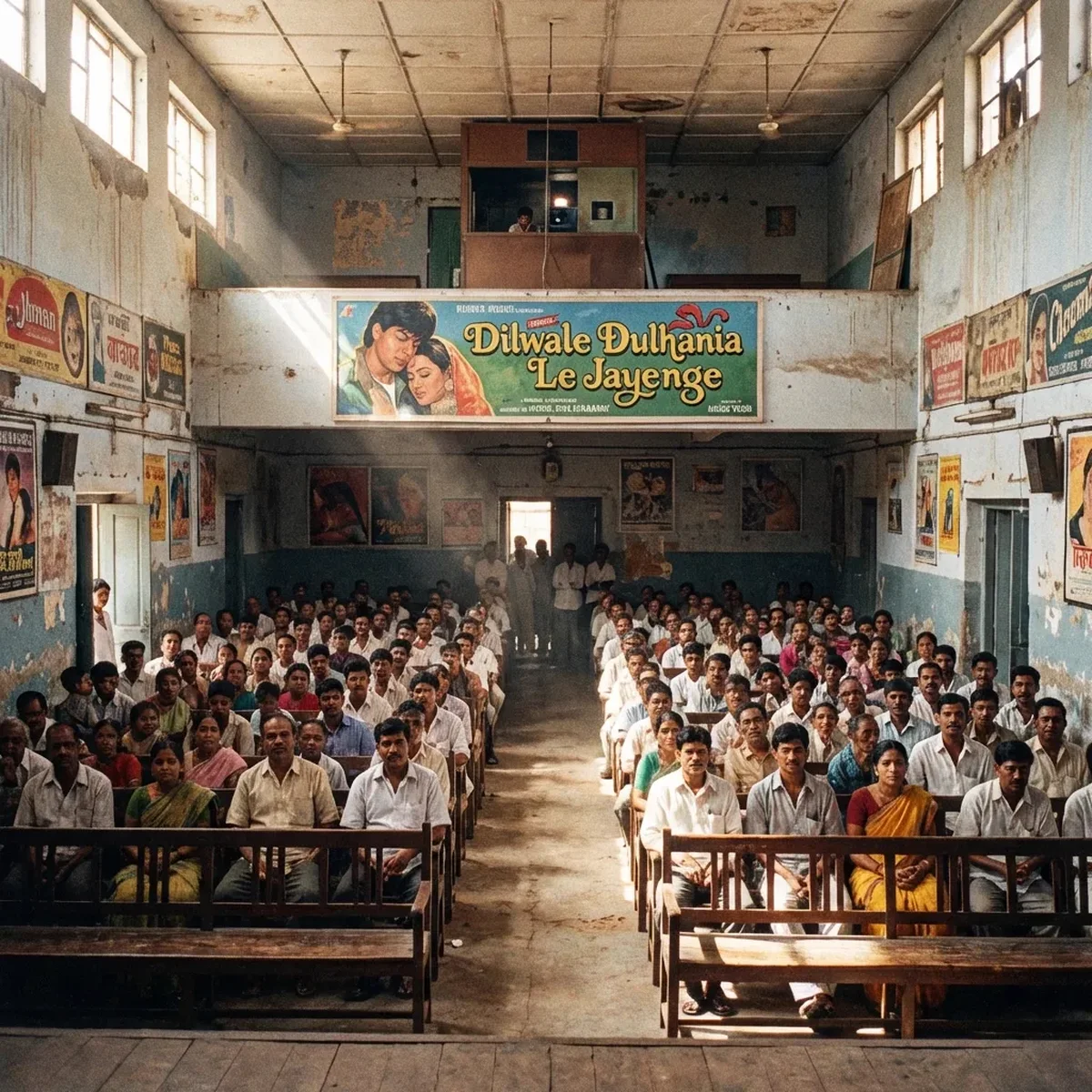
₹4,200 minimum. That's what a family of four pays now for a single movie outing — tickets, parking, snacks, and maybe dinner. Back in 2005, the same night cost ₹380. We're not talking about luxury here. Just a regular weekend show at a standard multiplex. I don't know when exactly popcorn became more expensive than the actual movie, but here we are.

The Complete Cost of a Movie Night Out: Then vs Now
Ticket prices alone don't tell the full story. A "movie night out" for a family of four involves tickets, snacks, parking, and often dinner before or after the show. When you add it all up, the numbers get uncomfortable fast. Here's what the same outing cost across three different eras.
| Expense Item | 2005 (Single Screen) | 2015 (Multiplex) | 2025 (Multiplex) |
|---|---|---|---|
| 4 Tickets (Weekend) | ₹120-200 | ₹600-800 | ₹1,400-2,000 |
| Popcorn (2 tubs) | ₹20-40 (from outside) | ₹300-500 | ₹600-900 |
| Cold Drinks (4) | ₹40-60 | ₹400-600 | ₹600-800 |
| Parking | ₹0-10 | ₹50-100 | ₹100-200 |
| Dinner (4 people) | ₹200-400 | ₹800-1,200 | ₹1,500-2,500 |
| Total Outing | ₹380-710 | ₹2,150-3,200 | ₹4,200-6,400 |
So we're looking at an 8-10x increase over 20 years, while household income probably grew 3-4x in the same period. What used to be a casual weekend thing — "Chalo, picture chalte hain" — now requires actual planning and budget allocation. I've seen families debate cinema trips the same way they'd debate buying a new phone. Most middle-class households I know now go 2-3 times a year max, saving it for Diwali releases or maybe a Marvel film.
2010 vs Now: When Tickets Were Still Reasonable
Back in 2010, a multiplex ticket ran you ₹150-200. Single screens were ₹50-80. Fast forward to today — a weekend show at PVR or Inox in any metro city hits ₹400-600 easily. That's a 3x jump, way faster than general inflation (which roughly doubled in that time).
Look, in the single-screen era, a family of four could watch a movie for under ₹500, snacks included. Same family today? You're dropping ₹2,500+ and that's if you're being careful about what you order at the counter.

The Single-Screen to Multiplex Transition: How PVR/INOX Killed ₹30 Tickets
In the 1990s, India had around 13,000 single-screen cinemas. Neighbourhood institutions — Regal in Mumbai, Satyam in Chennai, Uphaar in Delhi, Menoka in Kolkata. Balcony tickets? ₹20-40. Stalls were ₹10-15. Some popcorn-wala outside sold fresh paper cones for ₹5. You could watch a film, grab samosas and cutting chai, and still pocket change from a ₹50 note.
The multiplex revolution kicked off in 1997 when PVR opened India's first multiplex in Saket, New Delhi. Four screens, cushioned seats, Dolby sound, and AC that actually worked. Tickets were ₹120 — four times what single screens charged. But the experience was so much better that urban audiences jumped on it immediately. By 2005, PVR, Inox, and Cinepolis had opened over 300 screens in malls across metro cities.
What happened next was pretty brutal. As multiplexes pulled in urban audiences, single screens hemorrhaged viewers. Distributors noticed multiplexes generated higher per-screen revenue and started giving them priority release dates and better print allocations. Single screens got pushed to second-week runs. Revenue tanked. Maintenance got deferred. Experience got worse, which drove away even more people. Classic death spiral.
Between 2005 and 2020, roughly 4,000 single-screen cinemas shut down permanently across India. Many got demolished to build shopping malls — sometimes the very malls that now house the multiplexes that replaced them. Hard to miss the irony there. Affordable entertainment got literally bulldozed to make room for the expensive version. By 2024, India's single-screen count had dropped below 6,000, and of those, many run at 15-25% occupancy, barely surviving on regional films and morning shows.
The PVR-INOX merger in 2023 created a monster controlling over 1,700 screens across India. Consolidation like that kills competition and hands the merged entity massive pricing power. When one company controls 40% of multiplex screens in a city, there's not much incentive to keep prices down. The ₹30 ticket didn't just die — it was strategically eliminated from the market.
The Popcorn Economics: Why ₹10 Becomes ₹350
Food markup inside Indian multiplexes is probably one of the worst examples of captive-market pricing anywhere. Let's trace a simple packet of popcorn from grain to whatever absurd price they're charging now.
Raw popcorn kernels cost maybe ₹30-40 per kg wholesale. One kg produces around 30-35 litres of popped popcorn — enough to fill 6-7 large tubs. Add butter flavouring (₹5 per tub), the paper tub itself (₹8-10), and labour and electricity (₹5 per tub), and you're looking at ₹12-15 total cost per tub. Multiplex sells this for ₹350-450. That's a 2,000-3,000% markup.
Cold drinks? Same story. A 300ml Pepsi costs the multiplex roughly ₹8-12 (including the branded paper cup). Sells for ₹180-250. Combo of large popcorn and a cold drink? ₹450-600. Raw material cost of that combo is under ₹25. Profit margin exceeds 90%.
This isn't accidental. It's the core business model. Multiplex chains openly acknowledge in their annual reports that F&B (Food and Beverage) revenue generates margins of 70-80%, compared to just 10-15% on ticket sales. Ticket margins are thin because distributors and production houses take 42-55% of ticket revenue in the first week, leaving multiplexes with barely enough to cover rent, staff salaries, and electricity. The ₹400 ticket doesn't pay for your experience — the ₹350 popcorn does.
Supreme Court addressed this in 2018 when it upheld the right of moviegoers to carry outside food and water into cinema halls. Ruling came after a PIL (Public Interest Litigation) argued that banning outside food in a captive environment was an unfair trade practice. Enforcement's been patchy at best, though. Most multiplexes still discourage outside food through bag checks, signage, and social pressure. Legal right exists on paper, but exercising it means arguing with security guards at the entrance — something most Indian families would rather skip.
Regional Pricing: Why Tamil Nadu Has Price Caps
Movie ticket pricing varies wildly across states in India, and those differences reveal a lot about entertainment politics in each region.
Tamil Nadu's probably the most regulated market. State government caps multiplex ticket prices at ₹150 for regular screens and ₹200 for premium formats. Caps are enforced under the Tamil Nadu Cinemas (Regulation) Act, which means watching a new Rajinikanth release in Chennai costs half what the same film costs in Mumbai or Bangalore. Caps exist because cinema's deeply tied to Tamil politics — actors become chief ministers, film fans form powerful vote banks, and affordable movie access gets treated as a public good.
Andhra Pradesh and Telangana have experimented with dynamic pricing rules. After audience backlash over ₹800+ tickets for RRR and Baahubali 2, AP government imposed ticket caps that vary by town tier: ₹150 in C-class towns, ₹200 in B-class, and ₹300 in A-class cities for multiplexes. Exhibitors challenged these caps in court but they've mostly been upheld.
Kerala, Karnataka, and Maharashtra have no formal price caps, and that's where ticket inflation runs freest. A Friday evening show of a major Hindi release at PVR Phoenix (Mumbai) can hit ₹700-800 for a standard seat, while the same film at the same chain in Chennai costs ₹150. Difference is entirely regulatory.
North Indian states — Uttar Pradesh, Rajasthan, Madhya Pradesh — fall somewhere in between. Ticket prices are lower than Mumbai or Bangalore (₹200-350 for multiplexes) partly because disposable incomes are lower and partly because single screens still have decent market share, providing competitive pressure that metros have lost.
Regional disparity means cinema inflation isn't uniform across the country. Hits hardest in unregulated metros and lightest in states where governments treat entertainment affordability as a political priority.
Economic Analysis: The F&B Trap
Connection between ticket prices and F&B (Food & Beverage) costs is the real story here. Multiplex chains run on thin margins for tickets because of distributor shares, making F&B their primary profit engine.
Let's break down the data. Using CPI (Consumer Price Index) numbers and historical market rates, you can see a clear picture of inflation's impact on this sector.
| Year | Price / Value | Inflation Adjusted (Approx) |
|---|---|---|
| 2010 | 100 (Index) | Base |
| 2024 | 240 (Index) | Inflationary Spike |
Data above shows a clear trend: costs effectively doubled in under 12 years.

Why The Price Explosion? Key Factors
It's not just simple inflation. Several structural factors seem to have contributed to this price surge:
- F&B Revenue Model: Cinema chains make their real profit on ₹400 popcorn and ₹300 Pepsi, where margins can exceed 800%.
- Real Estate Costs: Malls charge massive rentals. A multiplex in a premium mall pays crores in rent, which is passed on to the ticket buyer.
- Virtual Print Fee (VPF): While this cost has reduced, the shift to digital projection required massive initial capex that is still being recovered.

The OTT Disruption: Netflix at Home vs the Multiplex
OTT platforms have seriously undercut the value of going to a cinema. Consider this comparison: a Netflix annual subscription costs ₹1,500-6,500 (depending on the plan). A Hotstar annual plan costs ₹899-1,499. Amazon Prime, which includes video streaming, costs ₹1,499/year. For a family of four, a combined Netflix + Hotstar subscription costs roughly ₹3,000-8,000 per year.
Now consider the cinema alternative. If the same family watches one movie per month at a multiplex — not even that often — annual cost is ₹30,000-50,000 (tickets + snacks alone). Even watching one movie every two months costs ₹15,000-25,000 annually. Math is brutal for cinema: a full year of unlimited OTT content costs less than a single multiplex visit for a family.
Equation's changed audience behavior permanently. Post-pandemic data from the Multiplex Association of India shows the average Indian moviegoer visits the cinema 1.2 times per year, down from 2.4 times in 2018. "Casual movie" — a mid-budget rom-com, a comedy, or a mid-week watch — has almost entirely migrated to OTT. People only go to the cinema for "event films" — a Pathaan, a KGF Chapter 2, a Marvel release, or a Rajinikanth opener. Selectivity means multiplexes must extract maximum revenue from fewer visits, which further inflates prices per visit. Vicious cycle.
OTT window — the gap between a film's theatrical release and its streaming debut — has also shrunk dramatically. In 2015, a film would take 4-6 months to appear on TV or DVD. Today, most Hindi films arrive on OTT within 4-8 weeks of theatrical release. Blockbusters get 6-10 weeks; flops barely last 3 weeks before getting sold to a streaming platform. Compressed window kills the urgency to see films in theatres. "I'll wait for it on Netflix" has become the default response for all but the most anticipated releases.
Premium Formats Inflation: IMAX, 4DX, Gold Class, and the Premiumization Trap
While standard multiplex ticket prices have tripled over 15 years, the real inflation frontier's probably premium formats. IMAX, 4DX, MX4D, ScreenX, Dolby Atmos, LUXE, and "Gold Class" recliners represent a new tier of cinema experience — and a new tier of pricing.
IMAX ticket in Mumbai costs ₹800-1,200. A 4DX experience (moving seats, wind, water sprays, scents) goes for ₹700-1,000. PVR's "Gold Class" — recliner seats with blankets, waiter service, and a dedicated lounge — charges ₹1,200-1,800 per seat. For a couple watching an IMAX film in Gold Class with a shared popcorn combo, the bill crosses ₹3,500 before they've even eaten dinner.
Premium formats barely existed in India before 2015. First IMAX screens opened in 2009-2010 (for Avatar). 4DX arrived in 2016. Gold Class and recliner formats expanded rapidly after 2017. In a decade, an entirely new pricing tier got created above the already-inflated standard multiplex ticket. "Premiumization" strategy's deliberate: as occupancy rates at standard screens decline (average occupancy in Indian multiplexes is just 25-30%), chains need higher revenue per seat from fewer customers. Premium formats, with their 3-4x ticket prices and dedicated F&B service, generate more revenue from a 50-seat recliner screen than from a 250-seat standard auditorium.
Catch is that premiumization makes cinema increasingly exclusionary. When Gold Class tickets cost what a family would spend on a week's groceries, cinema becomes a luxury good, not mass entertainment. Cultural shift's pretty significant: for previous generations, watching a film was a democratic act. For the current generation, it's increasingly segmented by what you can afford — just like air travel, which moved from a single cabin to Economy, Premium Economy, Business, and First Class.
The Economics of Film Production: How ₹100 Crore Became the New Normal
Ticket prices don't exist in isolation. They're linked to film production budgets, which have inflated at a staggering pace. In 2005, a typical big-budget Hindi film cost ₹15-25 Crores to make. By 2015, that had risen to ₹80-150 Crores. In 2025, tent-pole productions routinely cost ₹200-400 Crores. Brahmastra cost an estimated ₹410 Crores. Pathaan reportedly cost ₹250 Crores. RRR's budget was over ₹550 Crores.
Star salaries are probably the single biggest driver. An A-list Hindi actor's fee has gone from ₹3-5 Crores in 2005 to ₹50-125 Crores in 2025. Some top stars now work on revenue-sharing models, taking 20-30% of box office collections instead of (or in addition to) a fixed fee. When a star takes ₹100 Crores from a film's budget, that cost's gotta be recovered from ticket buyers.
Marketing budgets have exploded too. A 2005 film might spend ₹2-3 Crores on promotion (posters, newspaper ads, TV spots). A 2025 film spends ₹30-60 Crores on marketing alone — digital campaigns, influencer partnerships, city tours, trailer launch events at IMAX screens, paid social media trends, and TV rights pre-sales that double as promotion. Cost of making India aware of a new film's risen 10-15x.
Financial model now requires films to gross ₹100 Crores just to break even, and ₹300+ Crores to be considered a genuine hit. Only possible if ticket prices are high enough to generate that revenue from a fixed number of screens (roughly 4,500 multiplex screens and 6,000 single screens nationwide). When a film needs ₹300 Crores from 10,000 screens in 4-6 weeks, the math demands average ticket prices of ₹300+ across the country. Inflation in production budgets directly fuels inflation at the ticket counter.
A Family of Four: How Movie Spending Changed from 1995 to 2025
Let's trace the movie-going journey of a hypothetical middle-class Indian family — two parents and two children — across three decades. Family earns the median household income for their era and lives in a Tier-1 city.
1995: The Golden Era of Affordable Cinema
Household income: ₹8,000-12,000/month. Family watches 2-3 movies per month at a neighbourhood single screen. Four balcony tickets cost ₹80-120. Buy samosas (₹10 for 4), chai (₹8 for 4 cups), and maybe a packet of Parle-G. Total outing cost: ₹100-150. Monthly cinema budget: ₹200-450, or roughly 2-4% of household income. Cinema's a routine weekly or biweekly activity, as normal as visiting relatives on Sunday.
2010: The Multiplex Transition
Household income: ₹35,000-55,000/month. Single screens in their neighbourhood have closed or deteriorated. Family drives to a mall multiplex. Four tickets: ₹600-800. Parking: ₹50. Popcorn and drinks (because the kids demand it): ₹500-700. Sometimes dinner at the mall food court afterward: ₹600-800. Total outing cost: ₹1,750-2,350. Family watches movies once a month, maybe once every six weeks. Monthly cinema budget: ₹1,750-2,350, or about 4-5% of household income. Percentage's actually gone up even though they watch fewer movies. Experience is better, but frequency's halved.
2025: The Premium Squeeze
Household income: ₹80,000-1,20,000/month. Family debates whether to go to the cinema at all. "It's coming on Netflix in a month," someone says. When they do go — for a big holiday release — four tickets cost ₹1,600-2,400. If the kids want IMAX, add another ₹400-800. Popcorn combo: ₹700-1,000. Parking at the mall: ₹100-200. Skip dinner at the mall because the total's already alarming. Total outing cost: ₹2,400-4,400. Family goes to the cinema 4-6 times per year. Annual cinema budget: ₹10,000-26,000, or roughly 1-2% of annual household income. Percentage's actually dropped because the family self-rationed, but each individual visit feels painful.
Transformation's clear: cinema went from a low-cost, high-frequency habit to a high-cost, low-frequency event. Middle-class family hasn't abandoned movies — they've abandoned the cinema hall. Movies are now consumed at home on OTT platforms, and the theatre's reserved for spectacle. Cultural loss is subtle but real: there's no shared audience experience, no collective gasp, no post-credits discussion with strangers when you watch a film alone on your phone.
Future Outlook: OTT vs The Big Screen
Seems like we're headed for a split. Standard movies will probably be consumed on OTT (Netflix/Prime) at home. Cinema will become an "event only" destination for big-budget spectacles (like Avatar or MCU movies).
Prices will likely shift to a premium model — fewer seats, recliners, waiter service — pushing the cost of a family movie night to ₹5,000+. Maybe higher.
The Single Screen Extinction and What We Lost
India once had over 13,000 single-screen cinemas. By 2024, that number had dropped below 6,000 and continues to shrink every year. Each closure removes an affordable entertainment option from the neighbourhood. Single screens charged ₹30-80 for a ticket and offered samosas and chai for ₹10-20. Great equalizer — a rickshaw driver and a shopkeeper sat in the same hall, watching the same Amitabh Bachchan film.
Multiplexes replaced this with tiered pricing. A "Gold Class" recliner seat can cost ₹1,200 for a single ticket, while the "Classic" option sits at ₹350-450. Segmentation mirrors the growing economic inequality in urban India. Entertainment, once a shared cultural experience, has become stratified by income bracket.
Loss extends beyond pricing. Single screens were community landmarks — Eros in Mumbai, Sangeet in Ahmedabad, Priya in Kolkata. Hosted special shows, morning matinees for senior citizens, and were gathering spots during festivals. Multiplexes inside malls offer convenience and comfort, but they lack this cultural identity entirely.
Smart Strategies: Getting More From Your Movie Budget
If you're a regular moviegoer, there are concrete ways to fight the multiplex premium. Choose weekday shows — most chains offer 20-40% discounts on Monday through Thursday screenings. Use bank-specific offers; credit cards from ICICI, HDFC, and SBI frequently bundle "Buy 1 Get 1" deals on platforms like BookMyShow.
Eat before you go. F&B markup inside a multiplex is staggering — a bottle of water that costs ₹20 at a shop retails for ₹60-80 inside the hall. A family of four can save ₹500-800 per visit simply by having dinner before the show. 2018 Supreme Court ruling technically allows outside food and water in cinemas, though enforcement remains inconsistent across chains.
Consider subscription models. PVR Passport and similar loyalty programs can bring per-ticket costs down to ₹150-200 if you watch 3-4 movies a month. For families who treat cinema as a regular outing rather than an occasional splurge, these memberships offer genuine savings that offset the inflationary trend.
The Verdict: How to Protect Your Wallet
Look, awareness is the first step. You've gotta budget for this inflation.

References & Data Sources:
- World Bank: India CPI Data (1960-2024)
- Reserve Bank of India (RBI) Historical Bulletins
- Market Data: Industry Reports