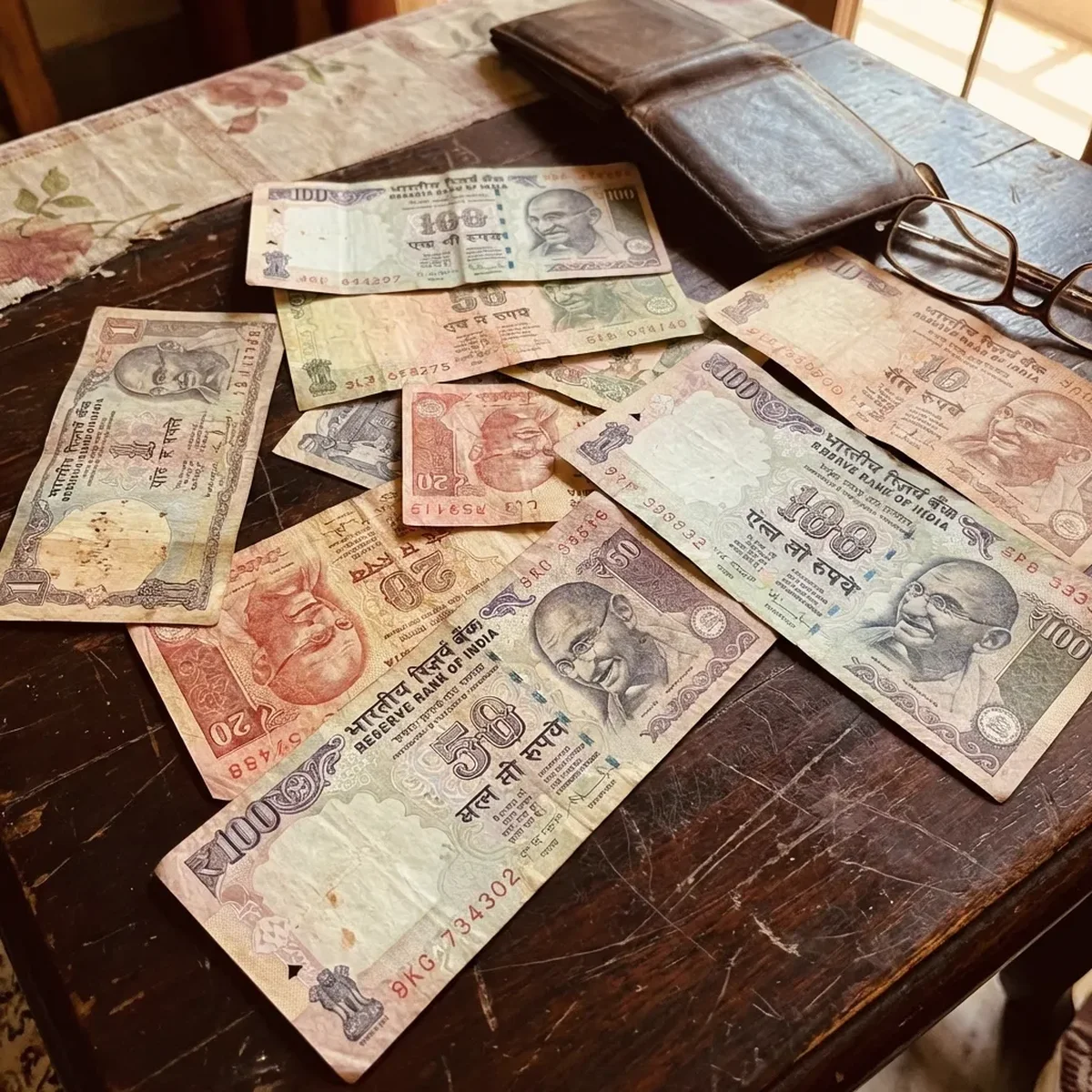
There's a particular smell that every Indian associates with train journeys. A mixture of chai, samosa, iron tracks, and that distinctive phenyl cleaning liquid they use on the floor. If I close my eyes and imagine it, I'm instantly transported to Platform 16 at New Delhi Railway Station, circa 2005, holding my first solo train ticket to Mumbai — Rajdhani Express, 3AC, ₹1,485.
I was 19. It was my first train journey without family. Mummy had packed enough food for a small army — aloo paratha wrapped in foil, pickle in a tiny container, Frooti, and a packet of Marie biscuits "just in case." Papa had pressed that ₹1,485 into my palm like it was a significant amount of money. Because it WAS a significant amount in 2005.
Last month, I booked the same train, same route, same class. ₹4,215. Nearly three times the cost. The paratha is the same (Mummy still insists), but everything else has changed. And the story of how Indian Railways fares evolved from "common man's transport" to "uncomfortably expensive" is really the story of India's relationship with subsidies, inflation, and political will.
A Brief History: When Trains Were Almost Free
Let me start with some context that might shock younger readers. Indian Railways has historically been one of the most subsidized transport systems in the world. In the 1990s, a general class ticket from Delhi to Mumbai (about 1,380 km) cost approximately ₹150. That's roughly 11 paise per kilometer. Essentially free.
How was this possible? Two words: cross-subsidy. Freight trains — carrying coal, iron ore, grains, cement — were charged significantly higher rates, and those profits subsidized passenger fares. Indian Railways' official data shows that for every ₹100 it spent carrying passengers, it earned only ₹57. The remaining ₹43 came from freight revenue.
This model worked when the railway was expanding, freight was growing, and governments didn't mind bleeding the nation's largest employer. But by the 2000s, cracks appeared. Freight started shifting to roads (trucks became cheaper and faster for many routes). Labour costs ballooned. The track needed upgrades. And passenger fares hadn't increased meaningfully in over a decade because no Finance Minister wanted to be the person who "raised the price of the common man's train ticket."
The Fare Timeline: Tracking Every Rupee
Let me present the data I've pieced together from Railway Budget documents, IRCTC records, and personal ticket stubs (yes, I'm one of those people who keeps everything). This is for the Delhi-Mumbai route, roughly 1,384 km:
| Year | General | Sleeper | 3AC | 2AC | Rajdhani 3AC |
|---|---|---|---|---|---|
| 2000 | ₹120 | ₹218 | ₹785 | ₹1,145 | ₹1,190 |
| 2005 | ₹158 | ₹327 | ₹1,050 | ₹1,520 | ₹1,485 |
| 2010 | ₹195 | ₹385 | ₹1,290 | ₹1,875 | ₹1,920 |
| 2014 | ₹270 | ₹470 | ₹1,580 | ₹2,310 | ₹2,520 |
| 2018 | ₹360 | ₹545 | ₹1,920 | ₹2,785 | ₹3,115 |
| 2022 | ₹415 | ₹640 | ₹2,350 | ₹3,420 | ₹3,650 |
| 2026 | ₹490 | ₹760 | ₹2,815 | ₹4,050 | ₹4,215 |
General Class: ₹120 → ₹490 (4.1x increase, CAGR 5.6%)
Sleeper: ₹218 → ₹760 (3.5x increase, CAGR 4.9%)
3AC: ₹785 → ₹2,815 (3.6x increase, CAGR 5.1%)
Rajdhani 3AC: ₹1,190 → ₹4,215 (3.5x increase, CAGR 5.0%)
CPI inflation over same period: ~5.2% CAGR
Interestingly, railway fares have mostly tracked general inflation — a rare example where a government-controlled price has moved somewhat rationally. But the devil is in the details, and those details are where the real inflation hides.
The Hidden Inflation: Charges Nobody Talks About
The base fare is just the starting point. Over the past 15 years, Indian Railways has become a masterclass in adding surcharges and fees that inflate the actual ticket cost well beyond the stated fare. Let me enumerate:
1. Superfast Surcharge
If your train is classified as "Superfast" (most long-distance trains are now), you pay an additional ₹30 for Sleeper, ₹45 for 3AC, ₹60 for 2AC. This surcharge didn't exist before 2003. It was introduced at ₹15 and has doubled since.
2. Reservation Charges
₹20 for General, ₹40 for Sleeper, ₹40 for 3AC, ₹50 for 2AC. These were ₹5-15 in the 2000s. A 3-4x increase that nobody notices because it's bundled into the ticket.
3. GST
Introduced in 2017 at 5% on AC classes. A Sleeper ticket is GST-exempt, but the moment you upgrade to 3AC, 5% GST is added. On a ₹2,815 ticket, that's ₹140 extra.
4. Catering Charges (Rajdhani/Shatabdi)
In 2005, my Rajdhani ticket included meals — dal, rice, curry, bread roll, and chai. The catering was basic but included in the fare. Today, catering charges are shown separately and have increased from roughly ₹200 included to ₹470+ shown as a line item. The food is marginally better, but the price increase is 135%.
5. Dynamic Pricing (The Big One)
In 2016, Indian Railways introduced dynamic pricing for Rajdhani, Shatabdi, and Duronto trains. This means that as seats fill up, prices increase — similar to airline pricing. The base fare for a Rajdhani 3AC to Mumbai might be ₹3,800, but book it 3 days before departure and you could pay ₹5,200-6,000 depending on demand.
This single change has really altered the economics of train travel. During festivals and holiday seasons, dynamic pricing can push train fares close to budget airline prices. I've personally seen Delhi-Mumbai Rajdhani 3AC at ₹5,800 during Diwali week, while IndiGo was quoting ₹4,500 for a 2-hour flight. When a train costs more than a plane, something has gone very wrong with the "common man's transport" narrative.
Every family's travel budget tells the same story — the numbers keep climbing
The Tatkal Tax: When Urgency Costs 200% Extra
No discussion of railway inflation is complete without talking about Tatkal booking. Introduced in 1997 as a convenience for last-minute travellers, it has become the most expensive way to travel by train.
In 2005, the Tatkal premium was ₹75 for Sleeper and ₹150 for 3AC. Reasonable. Today? It's 10% of fare for Second Class (min ₹10, max ₹15), 30% for Sleeper (min ₹100, max ₹200), and 30% for AC classes (min ₹300, max ₹400 for 3AC; min ₹400, max ₹500 for 2AC). Plus a flat Tatkal charge.
This means a Delhi-Mumbai Sleeper ticket that costs ₹760 normally could cost ₹960 through Tatkal. A 3AC ticket of ₹2,815 could become ₹3,615. And this is before the touts and agents who use software to corner Tatkal tickets and resell them at an even higher premium.
Every Indian who has experienced the IRCTC Tatkal booking process at 10 AM knows the unique combination of anxiety, frustration, and anger it produces. You sit with three devices, multiple browsers, and prayers — and still end up on the waitlist. The entire experience has become a metaphor for Indian inflation: you pay more and more, for less and less certainty.
The Platform Ticket: India's Smallest Inflation Indicator
Let me tell you about the most underrated inflation indicator in India: the platform ticket.
In 2000, a platform ticket cost ₹3. Yes, three rupees. You could walk into any railway station, see off your relatives, watch trains, eat railway canteen samosas, and enjoy the whole experience for the price of a toffee.
By 2010, it was ₹5. By 2015, ₹10. Then somewhere around COVID, many stations quietly raised it to ₹30-50. During peak seasons, some major stations charge ₹50. That's a 1,567% increase from the ₹3 base.
Now, ₹50 is still cheap in absolute terms. But the platform ticket encapsulates something important about Indian inflation: it's not always about the big numbers. It's about the quiet, unnoticed increases in hundreds of small items that collectively erode purchasing power. Nobody protests a ₹50 platform ticket. But multiply that logic across 10,000 similar small increases — postcard prices, bus fares, PDS grain rates, stamp duty — and you see how the common man's budget gets squeezed from a thousand tiny cuts.
My Father's Railway Stories: Perspective Across Generations
When I told Papa about this article, he laughed. "Beta, tum kya jaano. Mere zamane mein train mein koi ticket hi nahi kharidta tha." He was joking — mostly. But he told me stories about taking the Howrah-Delhi route in the 1980s in General Class for ₹45. Forty-five rupees for a 1,500 km journey. The compartment was so packed that people sat on the roof, hung from doors, and slept in the luggage rack.
"Par baithne ko jagah milti thi," he said. "Ab ₹500 deke bhi confirm seat nahi milti."
That observation cuts to the heart of the issue. It's not just that prices have increased — it's that the product hasn't improved proportionally. In the 1980s, ₹45 got you a guaranteed (if uncomfortable) spot. In 2026, ₹760 for Sleeper class often lands you on a waitlist. The inflation isn't just in money — it's in the gap between what you pay and what you receive.
Papa's generation accepted that trains were cheap and uncomfortable. My generation is stuck in a weird middle — trains are no longer cheap but they're still uncomfortable. We're paying premium prices for a service that was designed for a subsidized era but hasn't been redesigned for a market-rate era.
Vande Bharat: Premium Trains, Premium Prices
The introduction of Vande Bharat Express (initially Train 18) in 2019 marked a watershed moment. For the first time, Indian Railways introduced a genuinely new, modern train and priced it at market rates from the start.
A Delhi-Varanasi Vande Bharat ticket in AC Chair Car costs approximately ₹1,635. The same route by Shatabdi costs ₹1,100. By regular mail express 3AC, about ₹850. Vande Bharat is 50-90% more expensive than alternatives.
The train is also genuinely better — faster (reaching up to 160 km/h), cleaner, with better seats and onboard catering. But it raises an important question: is Indian Railways splitting into a two-tier system? Premium trains for those who can afford it, and deteriorating regular trains for those who can't?
By 2026, India has over 100 Vande Bharat services running. They're consistently full — clearly there's demand at these prices. But the expansion of premium services often comes at the cost of maintenance and investment in regular trains. Walk through a general class compartment of a regular mail express and then board a Vande Bharat. The contrast is jarring — and it reveals the growing inequality in Indian public transport.
Train travel budgets — a family expense that has grown far beyond simple inflation
The Comparison That Hurts: Train vs Bus vs Flight
Here's something that would have been unthinkable in 2005: for many routes, trains are no longer the cheapest option.
| Delhi to Mumbai (2026) | Price Range | Duration | Cost per Hour |
|---|---|---|---|
| Sleeper Class | ₹760-960 | 16-18 hours | ₹45-55 |
| 3AC | ₹2,815-3,600 | 16-18 hours | ₹165-210 |
| Rajdhani 3AC | ₹4,215-5,800 | 13-15 hours | ₹300-415 |
| Volvo Bus (AC Sleeper) | ₹1,800-2,800 | 20-24 hours | ₹85-130 |
| Budget Airline | ₹3,500-7,000 | 2-2.5 hours | ₹1,500-3,000 |
Notice something? A Rajdhani 3AC ticket at ₹5,000+ is in the same range as a budget flight at ₹4,500-5,500 if booked 15-20 days in advance. The flight takes 2 hours; the train takes 15 hours. The value proposition of premium train travel has collapsed.
Even in the budget segment, AC sleeper buses compete directly with 3AC trains at similar prices but often with better availability (no waitlists) and comparable comfort (fully flat beds vs side upper berths).
This competitive pressure is forcing Indian Railways to rethink its pricing — but the institutional inertia of a 170-year-old organization means change happens slowly, while private airlines and bus operators adapt in real time.
What All This Means for the Indian Family
Let me put this in household terms. Consider a family of four travelling from Delhi to their hometown in Bihar (Patna, roughly 1,000 km) for Chhath Puja:
Year 2005:
4 Sleeper tickets × ₹275 = ₹1,100
Tatkal premium (if needed): ₹300
Meals on train: ₹300
Total: ₹1,400-1,700
Year 2026:
4 Sleeper tickets × ₹640 = ₹2,560
Tatkal premium (if needed): ₹800
Meals on train: ₹800
Total: ₹3,360-4,160
Increase: 140-145%
For a migrant worker earning ₹15,000/month, this round trip (₹6,700-8,300 return) represents nearly half their monthly income. Festivals, which are meant to bring families together, have become a financial burden partly because of railway fare inflation.
I've spoken to several migrant workers at New Delhi station for this article. One of them, Ramesh bhai from Bihar, told me: "Pehle saal mein 3-4 baar ghar jaata tha. Ab sirf Chhath pe. Bahut mehnga ho gaya." He earns ₹18,000/month as a construction worker. Going home more than once a year is a luxury he can no longer afford.
The Silver Lining: What's Actually Improved
It would be unfair to present only the inflation side without acknowledging genuine improvements. Over the past decade, Indian Railways HAS improved in several areas:
- IRCTC Online Booking: Eliminated the need to stand in queues for hours. The system handles 20 lakh+ bookings per day
- Cleanliness: The Swachh Rail campaign, bio-toilets on trains, and station cleaning contracts have made a visible difference
- Safety: Anti-collision systems (Kavach), track upgrades, and elimination of unmanned level crossings have reduced accident rates
- Speed: Average speed of mail/express trains has increased from 50 km/h to 55-60 km/h (still slow, but improving)
- Station Upgrades: Major stations have gotten modern amenities — escalators, Wi-Fi, improved waiting rooms
- Food Quality: IRCTC's catering has improved especially from the days of grey paneer and rubber rotis
So the fare increase hasn't been entirely without benefit. But the fundamental question remains: have the improvements justified a 3.5x price increase? Most frequent travellers I've spoken to say no — they'd trade the marginally better food for a 2005 Rajdhani price any day.
Final Thoughts: The Democratization Premium
Indian Railways has always been more than a transport system. It's a cultural institution. It's where college students discover independence, migrant workers maintain family bonds, and chaiwallas build micro-businesses. The ₹3 platform ticket wasn't just cheap — it was a statement that railways belong to everyone.
When that ticket becomes ₹50, when Sleeper fares track inflation year after year, when dynamic pricing pushes Rajdhani into airline territory — we're slowly eroding that democratic promise. Yes, railways need to be financially sustainable. Yes, cross-subsidies from freight have limits. But the increasing unaffordability of train travel for the bottom 40% of India is a policy failure that fare data alone can't capture.
Next time you book a train ticket and wince at the amount, remember: it's not just market forces at play. It's the entire weight of India's fiscal constraints, energy costs, labour economics, and political calculations — all compressed into that one number flashing on your IRCTC confirmation page.
And somewhere, a young engineering student is calculating whether they can afford to go home for Holi this year. The answer increasingly, heartbreakingly, is: not this time.
Use our Inflation Calculator to convert your old train ticket prices to today's value. You might be surprised to find that railways have actually been one of the more restrained inflators — the real damage comes from all the surcharges and premiums piled on top.