
The Indian dream has always been tied to owning a house. But somewhere in the last two decades, real estate prices in major metros completely broke away from what people actually earn. The math that worked for our parents doesn't work anymore — and I'm not sure it's coming back.

When Buying a Flat Actually Made Sense
In 2000, people bought flats because they needed somewhere to live. Not as an investment thesis. A 2BHK in Mumbai's suburbs — Goregaon, Malad — cost ₹15-20 Lakhs. A decent salary was ₹3-4 Lakhs a year. That's a 5x ratio. Manageable. Today, that same flat is ₹2 Crores, while a decent salary is maybe ₹15-20 Lakhs. The ratio's blown out to 10-12x. That's not a market — it's a wall.
Six Cities, Same Problem
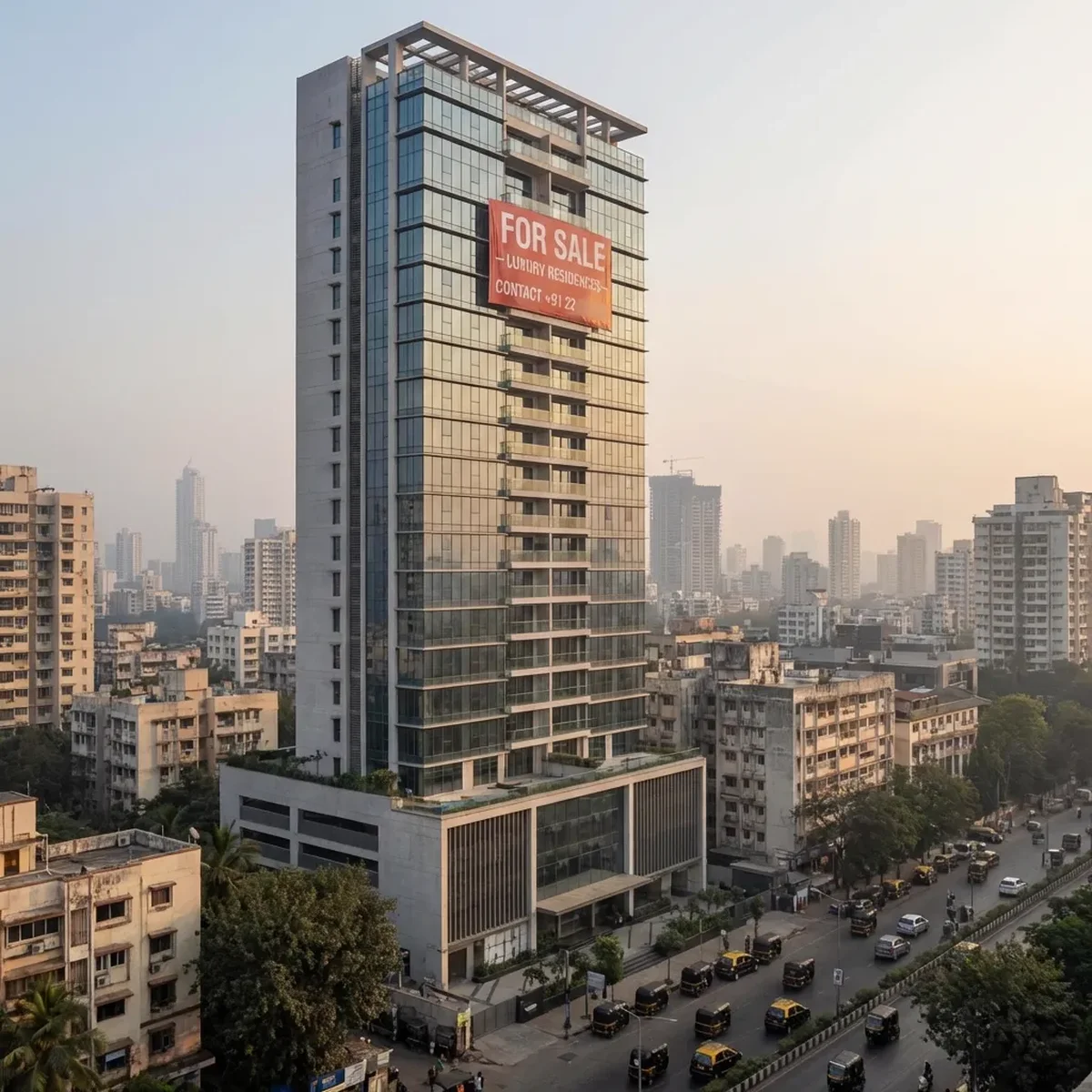
Mumbai and Bangalore grab headlines, but this isn't just a two-city problem. Here's what per-square-foot rates look like across six metros at three points in time. Data's from NHB RESIDEX, Knight Frank India, and state ready reckoner rates.
| City | 2000 (per sqft) | 2010 (per sqft) | 2024 (per sqft) | 24-Year CAGR |
|---|---|---|---|---|
| Mumbai (Suburbs) | ₹2,490 | ₹8,200 | ₹26,780 | 10.3% |
| Delhi-NCR (Gurgaon) | ₹1,800 | ₹6,500 | ₹14,200 | 8.9% |
| Bangalore (Whitefield) | ₹1,200 | ₹3,800 | ₹9,932 | 9.1% |
| Hyderabad (Gachibowli) | ₹900 | ₹3,200 | ₹9,500 | 10.2% |
| Pune (Hinjewadi) | ₹800 | ₹3,400 | ₹7,800 | 9.8% |
| Chennai (OMR) | ₹1,100 | ₹3,600 | ₹7,200 | 8.1% |
Hyderabad's the standout here, quietly matching Mumbai's CAGR despite starting from a much lower base. Telangana government's proactive infrastructure investment — the Outer Ring Road and the pharma-IT corridor around Gachibowli and Financial District — turned once-sleepy suburbs into premium real estate zones. Between 2018 and 2024 alone, Hyderabad prices jumped nearly 65%, driven by Amazon, Google, and Microsoft campus expansions in the region.
Delhi-NCR presents a cautionary tale. Gurgaon prices surged from 2005 to 2013, fuelled by the DLF-led construction boom and the metro expansion. But the Unitech-Jaypee defaults left thousands of buyers stranded in incomplete projects across Noida and Greater Noida. Between 2014 and 2020, prices in many NCR micro-markets actually fell in real terms. The recovery since 2021 has been selective — Dwarka Expressway and Golf Course Extension Road have rebounded, while sectors along the Yamuna Expressway still struggle with oversupply.
The Salary-to-Home-Price Ratio: How Many Years to Buy a 2BHK?
Price-to-income ratio's probably the most revealing affordability metric — how many years of gross annual salary does it take to buy a standard 2BHK (roughly 800-1000 sq ft) in each city? Global benchmark for a "healthy" housing market? 3-5x. Anything above 7x gets labeled severely unaffordable by the Demographia International Housing Affordability Survey methodology.
| City | Avg 2BHK Price (2024) | Avg IT Salary (Annual) | Years of Salary |
|---|---|---|---|
| Mumbai | ₹2.4 Cr | ₹18 L | 13.3x |
| Delhi-NCR | ₹1.3 Cr | ₹16 L | 8.1x |
| Bangalore | ₹95 L | ₹18 L | 5.3x |
| Hyderabad | ₹85 L | ₹14 L | 6.1x |
| Pune | ₹70 L | ₹14 L | 5.0x |
| Chennai | ₹65 L | ₹13 L | 5.0x |
Mumbai sits in a league of its own — at 13.3x, it rivals Hong Kong and London in unaffordability. Median household in Mumbai would need over a decade of gross income (before taxes, before living expenses) just to match the sticker price of a modest suburban 2BHK. Can't be sustained long-term. That's why the percentage of buyers under 35 in Mumbai dropped from 42% in 2010 to just 19% in 2024, according to CREDAI survey data. Young professionals are either renting indefinitely or moving to Pune and Bangalore where the ratios are far more reasonable.
EMI Burden Analysis: A ₹50 Lakh Loan Then vs Now
Let us compare what a ₹50 Lakh home loan looked like in 2000 versus 2024. The difference is stark, but not always in the direction people assume.
In 2000, home loan interest rates hovered around 12-13% (HDFC's standard rate was 12.5%). A ₹50 Lakh loan at 12.5% for 20 years meant an EMI of approximately ₹56,800. The total payout over 20 years: ₹1.36 Crores — you paid ₹86 Lakhs in interest alone. However, ₹50 Lakhs in 2000 bought you a spacious 3BHK in a prime Mumbai suburb like Andheri West or a villa in Bangalore's Koramangala.
In 2024, home loan rates sit at 8.5-9.0%. A ₹50 Lakh loan at 8.75% for 20 years gives an EMI of roughly ₹44,200. Total payout: ₹1.06 Crores, with ₹56 Lakhs in interest. The EMI is lower, the total interest paid is lower — but here is the catch. ₹50 Lakhs in 2024 buys you practically nothing in Mumbai or even Bangalore. It might get you a 1BHK in a distant Navi Mumbai suburb or a studio apartment in Bangalore's electronic city outskirts. To buy the equivalent of what ₹50 Lakhs bought in 2000, you now need a ₹2.5-3 Crore loan, which pushes the EMI to ₹2.2-2.6 Lakhs per month — well beyond the comfort zone of even a dual-income household earning ₹40-50 Lakhs annually.
Economic Analysis: The Decoupling
While incomes have risen (IT salaries have jumped 6-8x since 2000), property prices have jumped 15-20x. The simple math of "Salary vs EMI" no longer works for a single income household.
| Year | Price / Value | Affordability Status |
|---|---|---|
| 2000 (Mum) | ₹2,490/sqft | Affordable (Single Income) |
| 2009 (Mum) | ₹3,784/sqft | Stretch (Dual Income preferred) |
| 2024 (Mum) | ₹26,780/sqft | Luxury / Inheritance Dependent |
| 2024 (Blr) | ₹9,932/sqft | Becoming Unaffordable |
The data above illustrates a clear trend: Bangalore has seen the highest appreciation in the last 5 years (79%), driven by the tech boom and post-COVID demand for larger homes.

The Builder-Buyer Trust Crisis: Delayed Projects and Ghost Towns
India's real estate story cannot be told without addressing the deep trust deficit between builders and buyers. According to ANAROCK Property Consultants, as of mid-2024, over 5.08 lakh housing units across the top 7 cities remain delayed or stalled — projects that were launched before 2020 and have not been delivered. The worst offenders are in the Delhi-NCR region, where Noida and Greater Noida alone account for nearly 1.73 lakh stuck units. Names like Jaypee Infratech, Amrapali Group, and Unitech became synonymous with buyer misery — thousands of families paid EMIs for years on flats they never received.
The Real Estate (Regulation and Development) Act, 2016 — better known as RERA — was supposed to fix this. And to its credit, RERA has brought some discipline. Builders can no longer advertise projects without registration. Carpet area is now the standard measurement (ending the "super built-up area" scam that inflated quoted sizes by 30-40%). Funds collected for a project must stay in an escrow account earmarked for that project. But enforcement remains patchy. State-level RERA bodies vary wildly in their effectiveness — Maharashtra's MahaRERA is considered the gold standard, while UP-RERA and Haryana-RERA have been criticised for being slow and toothless.
The human cost is enormous. Families who booked apartments in 2012-2014, expecting delivery within 3-4 years, found themselves paying both EMI and rent simultaneously in 2024 — a decade later — with no completion in sight. Some projects have turned into literal ghost towns: concrete skeletons rising from overgrown weeds on the Yamuna Expressway, monuments to broken promises. For the millennial buyer, this history breeds deep scepticism. It explains the strong shift toward ready-to-move-in properties, which now command a 15-20% premium over under-construction flats in most markets.
Ready Reckoner Rates vs Actual Market Rates: The Dual Pricing Reality
India has a peculiar dual pricing system for property. Every state government publishes annual "ready reckoner" rates (called circle rates in North India or guidance values in the South) — the minimum per-sqft value at which property transactions can be registered. In theory, the actual market price should be close to the circle rate. In practice, the two can diverge wildly.
In premium locations, the actual market price far exceeds the circle rate. A flat in Mumbai's Bandra West might have a ready reckoner rate of ₹45,000 per sqft, but the actual selling price could be ₹65,000-80,000 per sqft. The buyer registers the transaction at the higher of the two (a 2001 amendment mandates stamp duty on actual value if it exceeds the circle rate), so the government captures its revenue. But in many tier-2 markets and even in some parts of NCR, circle rates can be higher than actual market rates — especially in areas with oversupply. This forces buyers to pay stamp duty on an inflated base, making already overpriced properties even more expensive on paper.
This gap creates arbitrage opportunities and also complicates the tax picture. Capital gains on property sales are calculated based on the higher of actual sale price or the circle rate. So even if you sell at a loss relative to what you paid, you may still owe capital gains tax if the circle rate has risen. For the average buyer, navigating this labyrinth without a competent chartered accountant is nearly impossible.
Why The Price Explosion? Key Factors
It's not just demand. Several structural taxes and costs have been added:
- Government Fees: Registration (6-7%), GST (5%), and various cess charges now make up 20% of the property cost. This "dead money" didn't exist to this extent 20 years ago.
- Input Costs: Cement and Steel prices are linked to global coal and energy prices. Construction cost alone has gone from ₹800/sqft to ₹2,500/sqft.
- Land Banking: In cities like Mumbai, artificial scarcity is created by developers holding land banks, keeping prices artificially high even with unsold inventory.
The Black Money Factor: Cash Transactions and Demonetization
For decades, a significant portion of Indian real estate transactions involved "black money" — unaccounted cash paid over and above the registered price. In the pre-2016 era, it was common for buyers to pay 30-50% of the property value in cash, with only the remainder reflected in the sale deed. This practice artificially inflated property prices because sellers could demand higher total amounts knowing the cash component was tax-free. A flat officially worth ₹50 Lakhs might actually change hands at ₹70-80 Lakhs, with the difference flowing as untraceable cash.
The November 2016 demonetization was supposed to disrupt this. And temporarily, it did. Transaction volumes dropped 40-50% in the following quarter. But the long-term impact on prices was muted. After an initial correction of 5-10% in most markets, prices stabilized and then resumed their upward march by 2019. The reasons are structural: real estate in India is still one of the few asset classes where large amounts of unaccounted wealth can be parked. While the cash component has shrunk (industry estimates suggest it has dropped from 30-40% to 10-15% of transactions post-demonetization and post-RERA), it has not disappeared. The introduction of PMLA (Prevention of Money Laundering Act) compliance for property registrations above ₹50 Lakhs and mandatory PAN-Aadhaar linkage have added friction, but the ingenuity of those seeking to park black money in property continues to find workarounds through benami transactions, shell companies, and over-invoiced construction contracts.
NRI Investment: How Remittance Money Inflates Indian Property Prices
India receives the highest remittances in the world — over $125 billion in 2023, according to the World Bank. A significant chunk of this money flows directly into real estate. NRI buyers, earning in dollars, pounds, or dirhams, find Indian property "cheap" relative to their income. A software engineer in the Bay Area earning $200,000 annually can comfortably buy a ₹1.5 Crore flat in Bangalore — the EMI feels trivial when converted from dollar earnings. This purchasing power disparity creates a floor under prices in tech-heavy cities.
Builders actively court NRI buyers with dedicated sales teams, Dubai-based property expos, and special NRI payment plans. Prestige Group, Sobha, and Brigade Enterprises all run aggressive NRI marketing campaigns. The RBI permits NRIs to buy residential property freely under FEMA regulations, and repatriation of sale proceeds (up to two properties) is straightforward. The result is that NRI demand keeps prices elevated in pockets like Whitefield, Sarjapur Road, Gachibowli, and OMR — exactly the areas where domestic buyers are being priced out. In some Bangalore micro-markets, NRI buyers account for 20-25% of all transactions, creating a price benchmark that local salary-earners simply cannot match.
Future Outlook: What to Expect in 2030
Tier-2 cities will likely see the next boom. Metros are saturating in terms of affordability, pushing demand to outskirts and satellite towns.
Based on current CAGR (Compound Annual Growth Rate) trends, we can project that prices in this sector will continue to rise, likely outpacing general CPI inflation due to increasing demand and resource scarcity.

The Impact of Work-From-Home on Real Estate Geography
The COVID-19 pandemic redrew the map of Indian real estate demand in ways that are still playing out. When major IT companies shifted to remote and hybrid work models in 2020-2021, a significant exodus began from expensive metros to tier-2 cities and satellite towns. Techies who had been paying ₹25,000-35,000 for a 1BHK in Bangalore's Koramangala suddenly discovered they could rent a 3BHK villa in Mysore or Coorg for less. Those from North India moved back to Jaipur, Lucknow, and Chandigarh. South Indian employees returned to Coimbatore, Vizag, and Kochi.
This migration had a measurable impact on property prices. According to Magicbricks data, property searches for tier-2 cities surged 45% between 2020 and 2022. Prices in Goa jumped 30-40% in just two years as remote workers and startups flocked there. Dehradun, Indore, and Mangalore saw double-digit price appreciation. Meanwhile, rental prices in core IT areas of Bangalore and Pune dipped 15-20% during 2020-2021 before recovering as companies mandated return-to-office in 2023-2024.
The lasting impact is the emergence of "satellite town" real estate corridors. Around Bangalore, areas like Nelmangala, Devanahalli (around the airport), and Hosur in neighbouring Tamil Nadu have seen massive new project launches. Around Pune, Talegaon and Chakan have emerged. Around Hyderabad, Shamshabad and Adibatla are the new frontiers. These areas offer 40-60% lower prices per sqft compared to city centres, and for hybrid workers who only need to commute 2-3 days a week, the trade-off is acceptable. This trend is structurally deflationary for core metro prices in the long run, as it expands the effective housing supply radius.
The Rent vs Buy Dilemma: Running the Numbers
Consider a 2BHK in Whitefield, Bangalore, priced at ₹1.2 Crores. With a 20% down payment, you take a ₹96 Lakh home loan at 8.5% for 20 years. Your EMI works out to roughly ₹83,000 per month. Add maintenance charges of ₹5,000-8,000, property tax, and insurance — your total monthly housing cost crosses ₹90,000. That same flat rents for ₹25,000-30,000 per month. The gap of ₹60,000+ per month, if invested in a diversified equity mutual fund at 12% CAGR, would grow to over ₹5.9 Crores in 20 years — far exceeding the likely appreciation of the flat itself.
That doesn't mean renting is always better. Owning gives you emotional security, protection from landlord whims, and freedom to change your living space however you want. But financially, the numbers in metros right now favour renting and investing the difference. The old "property always goes up" rule probably needs a hard second look when rental yields sit at 2-3% while FDs offer 7% and equities have historically delivered 12-15%.
The Hidden Costs Nobody Talks About
When buyers calculate affordability, they often focus solely on the per-sqft price and EMI. But the true cost of property ownership in India involves several hidden charges that can add 25-30% to the base price. Stamp duty and registration alone account for 6-8% depending on the state. GST at 5% applies to under-construction properties. Interior fit-out for a bare-shell flat easily runs ₹10-15 Lakhs for a modest 2BHK — flooring, modular kitchen, wardrobes, electrical fittings, and painting all add up quickly.
Then there are recurring costs: society maintenance (₹3-8 per sqft monthly), property tax (increasing annually), and periodic repairs. A 10-year-old apartment typically needs waterproofing, plumbing fixes, and repainting that can cost ₹2-4 Lakhs. For those who bought in the early 2000s, these costs were manageable because the base price was low. For today's buyers stretching to afford ₹1-2 Crore flats, these extras can push the total cost of ownership well beyond what they originally budgeted.
The smartest approach for young professionals in Indian metros today is to delay the purchase by 3-5 years, build a corpus through SIPs, and aim for a 30-40% down payment instead of the minimum 20%. A larger down payment dramatically reduces your interest burden and brings the EMI-to-income ratio into a comfortable zone below 35%.
Why Indian Real Estate Returns Are Often Illusory
Ask any property owner about their returns, and they will proudly quote the difference between their purchase price and today's "market value." A flat bought for ₹30 Lakhs in 2005 and now "worth" ₹1.2 Crores looks like a 4x return — roughly 7.5% CAGR over 19 years. Not bad, right? But this headline number is deeply misleading because it ignores several costs that silently erode the real return.
First, there's the interest on the home loan. If 80% of that ₹30 Lakh purchase was financed at 10.5% for 20 years, total interest paid comes to roughly ₹29 Lakhs — nearly doubling the effective cost to ₹59 Lakhs. Then add registration and stamp duty (₹2-3 Lakhs), interior work (₹3-5 Lakhs), and society formation charges. All-in, you're looking at ₹65-67 Lakhs.
Now factor in 19 years of maintenance charges (averaging ₹3,000/month, totalling ₹6.84 Lakhs), property tax (roughly ₹8,000-12,000 per year, totalling ₹1.5-2.3 Lakhs), and at least two rounds of major repairs and repainting (₹3-4 Lakhs). The total cost of ownership crosses ₹77-80 Lakhs. Against a current value of ₹1.2 Crores, the net gain is ₹40-43 Lakhs over 19 years — a real CAGR of roughly 2.5-3%. That barely beats a savings account, and it significantly underperforms a simple Nifty 50 index fund that delivered about 12-13% CAGR over the same period.
There is also the opportunity cost of the down payment. That ₹6 Lakhs locked into the property in 2005, if invested in an equity mutual fund at 12% CAGR, would have grown to approximately ₹52 Lakhs by 2024. Real estate looks like a wealth creator only when you ignore the money you spent maintaining it, the interest you paid to the bank, and what your money could have earned elsewhere. For the generation that bought in the 1990s at rock-bottom prices, the numbers work. For anyone buying at today's elevated prices, the math is far less forgiving.
The Verdict: How to Protect Your Wealth
For pure investment, Real Estate offers poor rental yields (2-3%). For consumption (living), it provides security. Do not confuse the two.
References & Data Sources:
- World Bank: India CPI Data (1960-2024)
- Reserve Bank of India (RBI) Historical Bulletins
- Market Data: NHB RESIDEX, Knight Frank India Reports