
Arre yaar, last week I was helping my neighbour's son fill his engineering admission form. The boy cleared JEE, got a decent rank, and was looking at private engineering colleges because his rank wasn't good enough for IITs or NITs.
The form asked for the first year fee deposit: ₹3,50,000.
Three lakh fifty thousand rupees. Just for one year. Just for a computer science seat in a private engineering college in Karnataka — not even a top-tier one. A "tier-2" college, if we're being honest.
The boy's father, a small shopkeeper, looked at me with eyes that said everything. "How will I manage?" he asked. I had no good answer.
That night, I pulled out my old marksheets. My engineering degree, completed in 2008, had a total fee (four years) of approximately ₹4 lakhs. That was for a private college in Maharashtra, considered expensive at the time.
Then I called my father. "Papa, you did engineering in 1982. How much did you pay in fees?"
He laughed. "Beta, I think total four years was maybe ₹2,000-2,500. Two thousand rupees. Maybe less."
I nearly dropped my phone.
The Three-Generation Fee Ladder
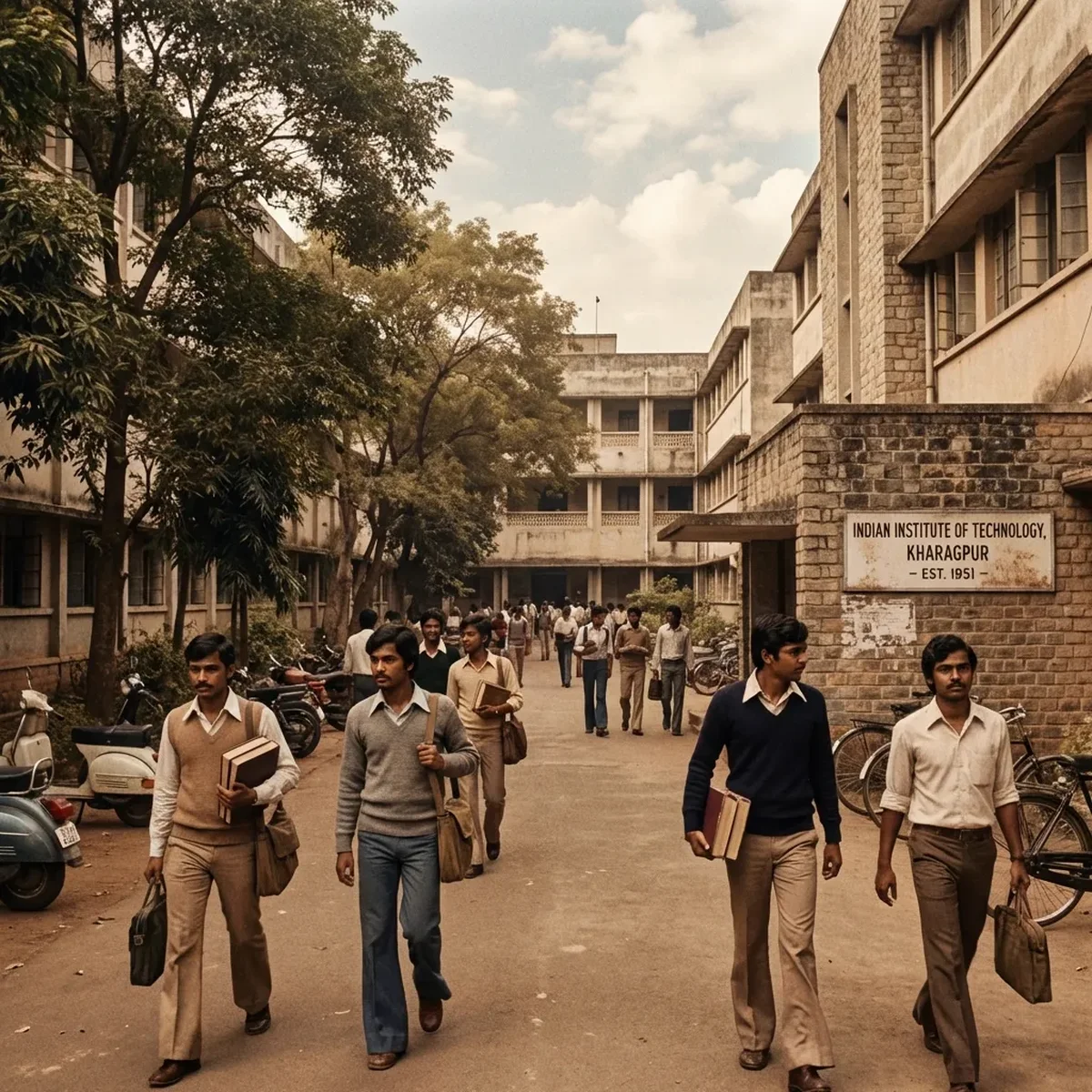
IIT Kharagpur in the 1980s - world-class education at almost no cost
Let me put this in a table, because I needed to see the numbers to believe them:
| Generation | Year | College Type | Total 4-Year Cost | As % of Annual Salary |
|---|---|---|---|---|
| My Father | 1982 | Govt. Engineering | ₹2,000 | 10% of one year |
| Me | 2008 | Private Engineering | ₹4,00,000 | 100% of one year |
| My Son (projected) | 2030 | Private Engineering | ₹20,00,000+ | 150%+ of one year |
Look at that progression carefully. My father's entire engineering education cost 10% of one year's salary. Mine cost 100% of one year's salary. My son's might cost more than 150% of an annual salary.
This is the great squeeze. Education costs are growing faster than incomes. Every generation has to work harder, save more, and still somehow come up short.
I think what most people get wrong about education inflation is they assume it follows general inflation. It doesn't — not even close. General CPI inflation in India has been roughly 6-7% over the last two decades. Education inflation has been running at probably 10-12%, sometimes higher. That means education costs double every 6-7 years, while salaries double every 10-12 years. The gap between what you can earn and what a degree costs is widening every single year. From what I've seen, families that planned their education fund based on "general inflation" projections end up with a 30-40% shortfall by the time the kid actually enters college. If you're saving for a child's education, you need to assume at least 10% annual inflation on education costs, not 6%. It seems like a small difference, but over 15 years, 10% vs 6% inflation means your target corpus is roughly 80% higher.
What Was College Like in 1982?
I asked my father to describe his college days. The picture he painted was so different from anything I experienced.
"Beta, there was no 'capitation fee.' You paid maybe ₹50-100 per semester. Books you could borrow from seniors or the library. Hostel was ₹10-15 per month, including food. The mess served three meals — dal, roti, sabzi, sometimes egg on Sundays. Simple but sufficient."
His monthly expenses, all-in: approximately ₹100. For everything — accommodation, food, books, and some pocket money for chai and movies.
"But how did the colleges run?" I asked. "₹50 per semester can't pay for professors and labs."
"Government paid," he said simply. "Education was treated as a public good. The best engineers were being produced in government colleges at nearly zero cost. IIT fee was ₹200 per year. Delhi College of Engineering was ₹50. These graduates went on to build ISRO, DRDO, and run companies worldwide. The investment in them paid back a thousand times."
The 2000s Shift: Private Money Changed the Game

The college fees counter - where dreams meet financial reality
During my admission in 2004, the scene had changed completely. Government college seats were few. Private engineering colleges had mushroomed everywhere. And the fee structure had become... creative.
I think what most people don't realize about this period is how fast the shift happened. In the 1990s, roughly 70-80% of engineering students were in government colleges. By 2005, that had flipped — maybe 30% government, 70% private. Private colleges set their own fees, and there was basically no cap on what they could charge. The market was booming because every middle-class family wanted their kid to be an engineer, and demand far outstripped government supply. Classic inflation setup: too many buyers, not enough seats.
My parents probably didn't think of it this way at the time, but looking back, the education market in the 2000s was the clearest example of demand-pull inflation I've ever seen. Families who'd been paying ₹5,000 per year at government colleges suddenly faced ₹70,000 per year at private ones — and felt grateful to get a seat. The "management quota" system, where you could buy a seat for ₹5-15 lakh in a good college, became normalized. It wasn't corruption in anyone's mind. It was "investment in the child's future." I'm honestly not sure whether to admire the parents who made those sacrifices or be angry at the system that forced them to.
Here's what my ₹4 lakh expense looked like:
- Tuition fees (4 years): ₹2,80,000
- Hostel + mess (4 years): ₹80,000
- Books and supplies: ₹20,000
- Exam fees, misc: ₹20,000
₹4 lakhs was considered "manageable" because my father had a decent government job and had saved wisely. But for many of my classmates, it meant education loans. The Vidya Lakshmi scheme existed, and banks were giving loans to engineering students, assuming their future salaries would pay back.
That assumption worked for some. IT jobs were booming. If you got placed, starting salaries of ₹3-4 lakhs could cover the loan in 2-3 years.
But the assumption failed for others. Mechanical engineers from tier-3 colleges. Civil engineers when real estate crashed. ECE students when hardware jobs disappeared. They graduated with ₹4-5 lakh loans and ₹15,000 per month jobs. The math never worked.
The Coaching Class Parallel Economy
Here's something my father's generation never dealt with: coaching classes.
In 1982, if you wanted to get into IIT or a good engineering college, you studied your NCERT books, maybe bought some "previous year papers," and gave the exam. Coaching existed, but it was limited and optional.
By 2004, coaching had become mandatory. I joined a coaching class in 11th standard. The fee was ₹40,000 for two years. Expensive, but my parents managed.
Today? Coaching fees for IIT-JEE preparation start at ₹1,50,000 and can go up to ₹5-6 lakhs for "integrated programs" that combine school and coaching. Add hostel in Kota and you're looking at ₹10 lakhs+ before the child even enters college.
| Year | JEE Coaching Fee (2 years) | Kota Hostel + Food | Total Pre-College Cost |
|---|---|---|---|
| 2000 | ₹40,000 | ₹30,000 | ₹70,000 |
| 2010 | ₹1,50,000 | ₹1,00,000 | ₹2,50,000 |
| 2025 | ₹4,00,000 | ₹3,00,000 | ₹7,00,000 |
So before getting into engineering college, a family might already have spent ₹7 lakhs. Then add ₹15-20 lakhs for the degree itself. The total investment to become an engineer: ₹25 lakhs+.
The Hidden Fees Nobody Tells You About
When colleges advertise "₹3 lakh per year," they're not lying, technically. But they're not telling the full story either. Here's what gets added:
- Admission fee (one-time): ₹50,000 - ₹1,00,000
- Development fee: ₹25,000 per year
- Lab fees: ₹15,000 per year
- Library fees: ₹5,000 per year
- Exam fees: ₹10,000 per year
- Sports fee, cultural fee, miscellaneous: ₹10,000 per year
A "₹3 lakh" college actually costs ₹3.75-4 lakhs. Over four years, that extra ₹3 lakh adds up. And nobody counts the hostel, food, travel home twice a year, and the laptop that every engineering student "needs."
The Loan Generation: My Colleagues' Stories
I graduated in 2008, right as the global financial crisis hit. It was a strange time. IT companies were still hiring but hesitant. Startups were struggling. And many of my batchmates had loans to repay.
There's one classmate I'll never forget. Let's call him Ramesh. Brilliant guy. Cleared IIT-JEE but his family couldn't afford the hostel and living costs in Bombay. He joined a mid-tier private college in our hometown instead, taking a ₹5 lakh education loan.
Ramesh got placed in an IT company at ₹3.5 LPA. After rent, food, and basic expenses in Hyderabad, he was left with maybe ₹8,000 per month. His EMI was ₹6,000. For five years, he lived on ₹2,000 per month of "discretionary income." No savings, no family support, no margin for error.
When his mother fell ill in year three, he had to borrow more. The cycle continued.
Ramesh is doing okay now — he got promotions, switched companies, makes a comfortable living. But he's 38 and still paying off the extended loan. His kids won't get the same "luxury" of education loans. They'll need scholarships, or they won't go to engineering college at all.
Honestly, Ramesh's story isn't even the worst case I've seen. I know at least three or four batchmates who took education loans for ₹4-5 lakh, graduated into a bad job market, couldn't find placements in their field, and ended up working call center jobs or retail to make the EMI payments. The loan didn't care that their degree wasn't paying off — the EMI still showed up every month. One of them defaulted, and his father's house (which was the collateral) nearly went into bank seizure. That's the thing about education loans that probably doesn't get discussed enough: unlike a business loan where you can at least sell the business, an education loan is secured against something you can't undo. You can't return the degree and get your money back. You're stuck with the debt regardless of whether the education delivered on its promise. Not sure there's an easy fix for this, but I think families need to do a much more honest ROI calculation before signing up for education loans — especially for tier-3 and tier-4 colleges where placement rates are maybe 30-40% at best.
What About Government Colleges Today?
The good news: IITs and NITs are still relatively affordable. IIT fees are approximately ₹2-2.5 lakhs per year, with liberal scholarship programs for economically weaker sections.
The bad news: there are only about 16,000 IIT seats for 15 lakh+ JEE aspirants every year. The acceptance rate is about 1%. NITs add another 20,000 seats. Even with government engineering colleges at the state level, total "affordable government seats" are maybe 1 lakh.
The remaining lakhs of aspirants either go to private colleges, switch to non-engineering courses, or give up on higher education entirely.
Planning for 2030: My Son's Future
My son is currently in 6th standard. If he wants to do engineering (and I'm not pushing him — that's his choice), he'll likely enter college around 2030.
Based on current inflation, here's my projection:
| Expense | 2025 Rate | 2030 Projection (8% inflation) |
|---|---|---|
| Coaching (2 years) | ₹4,00,000 | ₹6,00,000 |
| Private Engineering (4 years) | ₹15,00,000 | ₹22,00,000 |
| Hostel + Living (4 years) | ₹6,00,000 | ₹9,00,000 |
| Total | ₹25,00,000 | ₹37,00,000 |
₹37 lakhs. Essentially the cost of a small flat in a tier-2 city. For one child's undergraduate education.
If he doesn't clear IIT (statistically probable), if he wants a premium specialization (data science, AI), if he needs a laptop and other equipment — we're looking at ₹40-45 lakhs.
What I'm Doing About It
After seeing these numbers, I've made some changes:
- Started a dedicated education fund: A SIP specifically for my son's education. I'm putting ₹15,000 per month into equity mutual funds. By 2030, this should grow to approximately ₹25-30 lakhs.
- Exploring education insurance: Some policies guarantee a payout at age 18-19, specifically for education. Worth considering despite the low returns.
- Keeping options open: Engineering isn't the only path. BBA, BSc, BCom at decent colleges cost ₹5-7 lakhs total. If his interests lie there, the financial pressure is much lower.
- Having honest conversations: We talk about money openly. He knows that "IIT jaana hai" isn't just about rank — it's about financial strategy too.
The Uncomfortable Question
There's a question I've been avoiding in this article: Is a ₹40 lakh engineering degree worth it?
In 1982, the answer was clearly yes. Free education, guaranteed job at the other end, lifelong career security.
In 2008, it was probably yes. ₹4 lakhs for a chance at ₹3-5 LPA jobs, growing to ₹20+ LPA over a career. Good ROI.
In 2030, I'm honestly not sure. ₹40 lakhs for a 2-3 year placement struggle, starting salary of maybe ₹5 LPA (which won't have grown that much), and an AI-disrupted job market. The math is getting shaky.
Maybe the answer is: it depends on where you go and what you study. An IIT education is still worth it. A top-tier NIT, maybe. A tier-2 private college... I'm genuinely not sure anymore.
Here's a comparison I keep coming back to. A kid who spends ₹40 lakh on a tier-2 private engineering degree in 2030 might start at ₹6-7 LPA — if they're lucky. That same ₹40 lakh, invested in a Nifty 50 index fund for 10 years at 12% CAGR, would become roughly ₹1.25 crore. So the engineering degree needs to generate at least ₹1.25 crore in additional lifetime earnings compared to what the kid would've earned without it. For IIT or NIT grads earning ₹20+ LPA within 5 years, that math probably works. For someone from a tier-3 college earning ₹4-5 LPA in a market flooded with engineers, it's hard to say whether the degree actually delivers that ROI. I'm not saying "don't go to college" — I think education has value beyond just salary numbers. But the financial calculation deserves more honesty than we usually give it. From what I've seen, too many families treat a degree as an automatic ticket to prosperity when it's really more like a lottery ticket with varying odds depending on where you study and what you study.
Use our Inflation Calculator to project future education costs or compare what your parents paid vs today's prices.
More on Education Costs in India
Before college even begins, private school fees are already draining Indian families — K-12 costs now run ₹12-40 lakhs at mid-range CBSE schools. For the macro view of why education at every level is outpacing CPI inflation, see our education inflation crisis analysis.