Here's a conversation that happened at most Indian dinner tables sometime in the last few years: "Papa, aapne retirement ke liye kitna save kiya hai?" Silence. An uncomfortable shift. Then: "Beta, tumhe tension lene ki zaroorat nahi. Pension aa jayegi."
That pension? ₹15,000-25,000/month for government employees. ₹0 for private sector workers. And the cost of living? Rising at 6-8% every single year. This is India's retirement crisis — and most families are sleepwalking into it.

The retirement conversation — one of the most important (and most avoided) family discussions in India
Why Indian Parents Are Financially Unprepared
This isn't about blame — it's about understanding the structural reasons why the generation retiring now (born 1955-1970) is underprepared:
1. They Were the "Savers, Not Investors" Generation
Our parents saved religiously — but in FDs, PPF, and LIC policies that gave 4-8% real returns. They didn't invest in equity because nobody explained it to them. The stock market was "satta" (gambling), not wealth building. Their savings grew, but not fast enough to beat the inflation they're now facing in retirement.
2. No Pension Culture in Private Sector
Government employees got defined-benefit pensions (monthly income for life). But India's private sector — which employs 90% of the workforce — has no pension system except EPF. And most people withdraw their EPF when changing jobs instead of letting it compound.
3. They Spent on Us, Not on Themselves
Our parents' financial priority was (in order): children's education, children's marriage, children's flat, and THEN retirement. By the time they finished funding our IIT coaching, our MBA, our wedding, and our flat's down payment — there was nothing left for their own retirement.
4. "Bacche Dekh Lenge" (The Children Will Take Care)
This was the traditional retirement plan. But with nuclear families, children in different cities (or countries), and dual-income households where both partners work, the "children as retirement plan" model is breaking down.
What Most People Get Wrong About Indian Retirement Planning
I think the single biggest misconception is that retirement costs go down as you age. People assume, "Well, I won't be commuting, I won't be eating out as much, I won't need new clothes." And that's probably true for the first 5-7 years of retirement. But here's what surprised me when I actually ran the numbers: after age 70, expenses don't decrease — they shift. You're spending less on food and transport, but you're spending way more on medicines, doctor visits, domestic help, and eventually nursing care. A couple I know in Pune thought they'd need ₹30,000/month in retirement. By the time both were 72, between diabetes management, blood pressure meds, a part-time helper, and regular cardiology checkups, their actual monthly spend was ₹55,000. They hadn't planned for that at all.
There's another thing that seems like common sense but isn't widely discussed: inflation doesn't stop when you retire. It sounds obvious when you say it out loud, but from what I've seen, most retirement plans are built around a fixed monthly number — "We'll need ₹40,000/month." That might work in year one. By year 15, that same lifestyle costs roughly ₹96,000/month at 6% inflation. Your corpus needs to not just generate income — it needs to generate growing income. This is why putting everything into FDs at retirement is probably a mistake. You need at least 20-30% in equity or equity-linked instruments even after you retire, just to keep up. Hard to say exactly what split works for everyone, but the all-FD approach is almost guaranteed to run out of money before you run out of years.
The Numbers: How Much Does Retirement Actually Cost?
Let's build a realistic retirement budget for a couple retiring in 2025 in a Tier-2 city:
| Monthly Expense | Current (2025) | In 10 Years (2035) | In 20 Years (2045) |
|---|---|---|---|
| Groceries & Food | ₹15,000 | ₹27,000 | ₹48,000 |
| Medicines & Healthcare | ₹8,000 | ₹22,000 | ₹60,000 |
| Utilities | ₹5,000 | ₹9,000 | ₹16,000 |
| House Maintenance | ₹3,000 | ₹5,400 | ₹9,700 |
| Transport | ₹3,000 | ₹5,400 | ₹9,700 |
| Personal & Misc | ₹6,000 | ₹10,800 | ₹19,400 |
| Total Monthly | ₹40,000 | ₹79,600 | ₹1,62,800 |
Notice the healthcare row? It goes from ₹8,000 to ₹60,000 in 20 years. Healthcare inflation for seniors runs at 12-15% annually — it's the single fastest-growing retirement expense and the least predictable one. One hospitalization can wipe out years of savings.
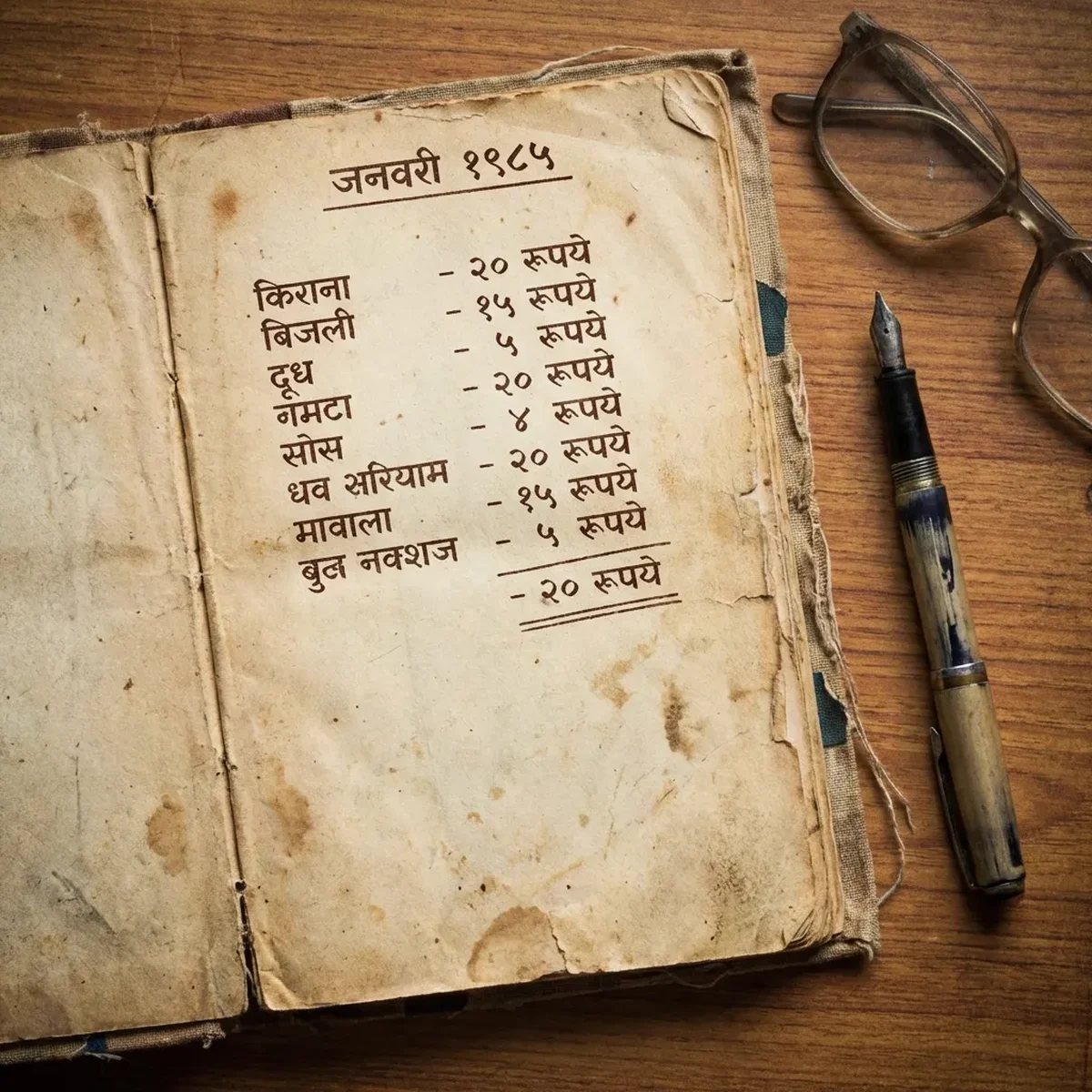
Planning the retirement budget — a task that becomes increasingly urgent as medical costs spiral
The Healthcare Time Bomb
Healthcare is the elephant in every Indian retirement plan. Consider:
| Medical Event | Cost in 2025 | Insurance Covers? |
|---|---|---|
| Knee Replacement (one knee) | ₹3-5 lakh | Partially (room rent sub-limits) |
| Heart Bypass Surgery | ₹4-8 lakh | Yes, but co-pay applies |
| Cancer Treatment (1 year) | ₹15-40 lakh | Partially (lifetime limits) |
| Monthly Chronic Disease Meds | ₹3,000-8,000/month | No (OPD usually excluded) |
| Home Nursing Care | ₹15,000-40,000/month | No |
My father's colleague retired in 2018 with ₹40 lakh in savings — a comfortable-sounding number. His wife needed hip replacement surgery in 2020 (₹4.5 lakh), he had a cardiac stent placement in 2022 (₹3 lakh), and their monthly medication bill is ₹6,000. In 5 years, their ₹40 lakh corpus has already dropped to ₹22 lakh. At this rate, they'll be financially dependent on their children by 2028.
Honestly, stories like this aren't rare — they're the norm. I've noticed that most Indian families treat health insurance for parents as an afterthought, something to think about "later." But later is too late. A 60-year-old couple can still get a ₹10 lakh family floater for maybe ₹25,000-35,000/year. At 70, that same policy — if you can even get it — costs ₹60,000-80,000/year with co-pay clauses and waiting periods. The math is pretty clear: for every year you delay buying your parents' health insurance, you're probably adding ₹15,000-20,000 to the annual premium. And that's assuming they don't develop a pre-existing condition in the meantime, which would make it even harder to get coverage. Not sure why this isn't talked about more, but the health insurance window for senior parents is narrow and closing fast.
The Sandwich Generation: You're Caught in the Middle
If you're 30-45 years old, you're likely part of the "sandwich generation" — financially supporting both aging parents AND growing children. This is uniquely challenging:
- Your EMI: ₹25,000-50,000/month for home loan
- Your kids' school: ₹15,000-40,000/month
- Parents' medical bills: ₹5,000-15,000/month
- Parents' living expenses: ₹15,000-25,000/month (if not earning)
- Your own retirement savings: ??? (often zero)
The cruelest irony? While supporting your parents' retirement, you're not saving for your own. The cycle continues.
What You Can Actually Do About This
I want to be honest — there's no magic fix here. If your parents are already 60+ with inadequate savings, you can't turn back time. But you can limit the damage and maybe build a structure that keeps things from getting worse. The specific actions depend on where your parents are in the timeline.
One thing I'd say before getting into specifics: have the conversation. I know it's uncomfortable — Indian families don't discuss money openly, especially not between generations. But sitting down with your parents and understanding exactly what they have (and don't have) is probably the single most valuable thing you can do. I've seen families where the kids assumed Dad had a pension, and he didn't. Or where Mom had an LIC policy she thought was worth ₹20 lakh but it was actually worth ₹4 lakh. The surprises are almost never pleasant. Better to know now than find out during a medical emergency at 2 AM.
From what I've seen talking to financial advisors who work with middle-class Indian families, roughly 70% of parents either don't have enough saved or don't have it structured properly. Money sitting in a savings account earning 3.5% while inflation runs at 6% is slowly being destroyed. Moving even half of that into Senior Citizen Savings Scheme (8.2%) or a balanced mutual fund could make a meaningful difference over 10-15 years.
If Your Parents Are 55+: Emergency Mode
- Health insurance: Get them ₹10-25 lakh family floater coverage IMMEDIATELY. After 65, premiums become prohibitively expensive and many insurers reject applications. The window is closing.
- Super top-up: Add a ₹50 lakh super top-up for ₹3,000-8,000/year. This covers major hospitalizations beyond the base policy.
- Audit their savings: List all FDs, PPF, Post Office deposits, LIC policies, property. Calculate the total. Compare against the ₹3-5 crore need.
- Monthly income plan: Structure their savings for monthly income: Senior Citizen Savings Scheme (8.2%, quarterly payouts), PM Vaya Vandana Yojana, and FD interest on a monthly basis.
If You're 30-45: Building the Cushion
- Start an NPS for yourself: ₹50,000/year for tax benefits + long-term equity growth
- PPF (max ₹1.5 lakh/year): Tax-free 7.1% compounding over 15 years
- Equity SIPs: ₹10,000-25,000/month in Nifty 50 index fund. Over 20 years, ₹15,000/month becomes approximately ₹1.2 crore at 12% CAGR
- Term insurance: ₹1 crore cover costs ₹8,000-15,000/year at age 30. This protects your family's retirement even if you're not around.

Our parents' generation knew how to save — but saving alone isn't enough to beat 25 years of inflation
The Magic of Starting Early: A ₹47 Lakh Difference
Consider two people who want ₹3 crore at age 60 through equity SIPs (assumed 12% CAGR):
| Start Age | Monthly SIP Needed | Total Investment | Total Interest Earned |
|---|---|---|---|
| 25 (35 years) | ₹4,100 | ₹17.2 lakh | ₹2.83 crore |
| 35 (25 years) | ₹15,800 | ₹47.4 lakh | ₹2.53 crore |
| 45 (15 years) | ₹64,000 | ₹1.15 crore | ₹1.85 crore |
Starting at 25, you need ₹4,100/month. Starting at 45, you need ₹64,000/month. Every decade of delay costs you roughly 4x more monthly investment for the same goal.
From what I've seen, the biggest barrier isn't the amount — it's the mental model. At 25, ₹4,100/month feels pointless. "That's barely a weekend dinner out." But that's exactly the trap. You dismiss small amounts because they don't feel meaningful today, and by the time large amounts feel urgent at 45, you can't afford ₹64,000/month because you've got EMIs, school fees, and maybe your parents' medical bills to handle. I think if there's one piece of advice worth repeating here, it's this: set up the SIP at 25 and forget about it. Don't check it monthly, don't stop it during market crashes, don't withdraw it for a vacation. Just let compounding do what it does. Seems like a simple idea, but doing it consistently for 30+ years is surprisingly difficult — and surprisingly rewarding.
The Verdict: Start the Conversation Today
The most powerful retirement tool isn't an SIP or PPF — it's a family conversation. Sit down with your parents. Ask them about their savings. Calculate the gap. Make a plan.
Yes, it's uncomfortable. Yes, they'll say "chinta mat karo." But the alternative — watching your parents worry about money at 75, or bankrupting yourself to fund their medical bills while your own retirement fund stays at zero — is far worse. I think this is maybe the most important financial conversation any Indian family can have, and it's the one almost nobody has. The families who do have it — early, honestly, with real numbers — are the ones who end up okay. Not rich, not stress-free, but okay. And in a country where retirement support systems are basically nonexistent for most people, "okay" is a genuinely good outcome.
The Pension Reality Check
Many Indian parents assume they'll have "pension" in retirement. Here's the reality across different employment types:
| Employment Type | Pension Available? | Monthly Amount (Typical) | Enough to Live On? |
|---|---|---|---|
| Central Government (pre-2004) | Yes — Old Pension Scheme | ₹25,000-80,000 | Mostly yes (with DA increases) |
| Central Government (post-2004) | NPS — market-linked | ₹10,000-40,000 (estimated) | Probably insufficient |
| State Government | Varies by state | ₹15,000-50,000 | Depends on state and DA |
| Private Sector (EPF/EPS) | EPS pension: ₹7,500/month max | ₹1,000-7,500 | Absolutely not |
| Self-employed/Business | No pension at all | ₹0 | Must self-fund entirely |
The shocking number: EPS (Employee Pension Scheme) for private sector employees caps at approximately ₹7,500/month. Your father who worked 35 years in a private company gets the same pension as a peon's grocery bill. That's why the EPF corpus (lump sum at retirement) is critical — but most people withdraw it partially during job changes, eroding the final amount.
Your Parents' Retirement Audit Checklist
Have this conversation with your parents this weekend. Go through each item:
- Total savings — FDs, PPF, EPF, postal savings, gold. Get the exact number, not "we have some savings."
- Monthly income sources — Pension, rental income, interest income. Calculate total vs total monthly expenses.
- Health insurance status — Do they have a policy? What's the sum insured? When does it expire? Is there a co-payment clause?
- Outstanding loans — Home loan, personal loan, credit card debt. Retirement with EMIs is a crisis.
- Property ownership — Is the house clear? Is it in their name? Is there a will?
- Monthly expense projection — What do they spend now? What will they spend at 70? At 80? Healthcare costs double every 5 years after 65.
Most families discover a ₹30-60 lakh gap between what parents have and what they'll need. That gap is YOUR responsibility to bridge — either through monthly support, lump-sum investments, or both. The earlier you identify it, the cheaper the solution.
Use our Retirement Calculator to see exactly how much your parents need — and our Inflation Calculator to understand how fast their expenses will grow.